Monday, December 01, 2008

Thaïs, Uganda, Renderings

Saw Thaïs last night, at the Palace 9 in Metropolitan's HD. At 20 bucks a pop, it's a lot cheaper than going down to New York and getting nosebleed seats, but maybe not quite as exciting. The HD has some special features, which is that you get sweeping views from all vistas and up close, and you get a behind-the-scenes look at backstage during the scene changes and intermissions. But that is also its downfall--the mood gets a little wrecked when you see the cast coming out of a scene, and then the guys pulling the sets about. But it was amazing to watch, nonetheless.

The Met's backstage is HUGE. The set pieces were enormous--even on rollers it took six guys to move them. They were pretty quiet. And in the third act, second to last scene, when Thomas Hampson (the baritone) was coming offstage I could swear he was wiping away tears (it's when Athanaël's grieving for Thaïs, before he sets off to see her die).

You could also see the electronics, and the director(?) signaling for "the maestro to the pit." The interviews were a little dorky, but I liked hearing Hampson's speaking voice--it's quite nice. I don't like Renee Fleming's speaking voice, but she sure nails this part, and she can look like a courtesan. I mean, Jane Eaglen or Jessye Norman couldn't really pull that off. But you know I also really liked Nicias (Schade)--he's a great character--talk about a bad guy you just can't hate. Athanaël is kind of unlikeable, as leading men go, but I guess you come around to him during the duet in the desert.

The thing that kept bothering me was that if this is supposed to be 3 or 400 AD, why is there a gun? (the supertitles say "I'll shoot you," but it could be arrows) And what's with the outfits? I'm okay with modern productions--I really liked the Beat La Boheme, but the costume and set design seemed all over time. I tried really hard to suspend disbelief, but they were quirky choices to make and I just kept noticing. If I had been in the nosebleed seats, it wouldn't have mattered--it's all so impressionistic from up there. Massenet's music is good--the parts you remember are overture, not arias, except for the duet which I really liked.

The people in the audience (my audience, in Burlington) were mildly irritating. All middle-aged or older (no problem there, but all coupled and no one to wink at) and some of them were like, "oh, I know so and so, he's the double-bass, see him there," and, "when I go down to NY I sit right there in the front row on the left..." Etc. As they say here, "Jeezum!" And there was a naggy woman/ self-important man couple that we saw in the Chinese restaurant before, and then at the show, who were positive eye-rollers. And then there was the woman who moved seats because it sounded "muffled." She needs a hearing test because the sound was spot-on. Anyway, moving on...

My mom's going to Uganda. And I'm jealous. I want to be pleased for her--it's an 8 day trip where she'll be setting up student visits at Kampala's city hospital, and maybe community health visits outside the hospital, maybe outside the city. I wish I were going. I wish I were useful. In Yale's magazine (this is a partnership with the Yale Med School and Kampala University) they said that 1/2 the population there is infected with HIV (I'm not surprised--I've heard the figures before--but seriously dismayed that things aren't improving) and that 2/3 of the patients at Mulago Hospital either don't survive or die within months of leaving. So it's a lot of palliative care--really the last resort for people who are very sick. Families move in with the patients to care for them because the hospital is so understaffed. In some ways, the city, and the university and the hospital seem modern, and in other ways not. There were pictures of the lab equipment online, as well as the laundry drying on the lawn. Anyway, like I said, I wish I were going.

As far as HIV goes, while I'm thinking about it, I've noticed a lot of startling behavior here in the US, where we should know better and have the preventative resources to avoid transmission. And still people meet up for anonymous encounters, insisting upon NO condom....? I don't know what to think. This is not the 1970s, by which I mean we can no longer claim innocence of a problem.

And finally, work. I'm doing some renderings for Chuck (Chuck's garage) and Doug (the builder). Having some problems, communication-wise, about modernity and traditional design, and what Doug wants versus what Chuck wants. Decided to go with a Greene and Greene style craftsman approach, with wooden supports under the cantilever, a shingled second story and custom doors. If Doug actually makes these doors, I will be (pleasantly) surprised.

Saturday, November 01, 2008

Philadelphia, Trip 2

So a few weeks ago I made my second jaunt to Philadelphia, this time not to see ESP, but for a history conference that I ended up not being registered for. Which was fine, because I got to see more of the city. I bring to you now, as a result, "Sightseeing Philadelphia the Miriam and Sarah Way:" (Sarah is Miriam's mom, by the way)

1. Whilst driving through Westchester County (on the way there, and the scenic route) get lost in beautiful Hudson River Valley locale, and then again in Yonkers, and then again in the Bronx. Especially in the Bronx. Circle around the zoo a couple of times, and then take a crosstown street back to 95 and cross the GW Bridge.

2. Get off at the wrong Philadelphia exit, too far north (to 73?) and then travel southward through northeast Philadelphia, taking note first of the odd, squat rowhouses, and then take Frankford south, a road that is reminiscent of South Wabash and either 55th or 59th Streets south in Chicago. Note the lack of Register to Vote volunteers in a neighborhood that might want a few. Hooray for the number of Obama t-shirts, however.

3. Keep looking for Penn's Landing. Seriously, it is there. Just keep driving.

4. Check into hotel. Note freakish and disturbing and large lobby painting. Look out at the Gazela, a sleek little boat moored nearby. Roll eyes re: conferencegoers with nametags.

5. Step out for a walk. If you cross the road there and veer left, you find lower Society Hill, a neighborhood that's a lot richer than it looks, and it looks rich already. Tight, neat, skinny townhouses, many renovated post 1966, but retaining, in many cases, the original colonial look. Since the neighborhood was skids in the 60s, the areas that were torn down now have recently-built townhomes, mostly in the modern style, so as not to detract from the real thing. Check out two modern sets--the ones with the gates that are different on every one, and give the looker a sense of the interior style... and also see if you can spot the house with the cats and dogs and birds gate, and the cat and mouse weathervane. Sweet.

6. Obama placards 4, McCain placards 1. Obama wins!

7. Keep walking along Pine until you hit the antiques district. Then walk up a few block toward convention center area, but not to CC. Count number of synagogues. Walk past Broad, to 16th and Spruce and have dinner at little Warsaw Cafe. Very atmospheric, cute youngish waiter and cute middle-aged owner (?), red glow, subtlely good food, and no rush. Bring 'em some business.

8. Walk up Broad and catch a glimpse of the City Hall which looks astonishingly like Gotham City at night, what with the fog around the top, the huge cast iron eagles and the weird yellow clock. I could not see the statue of William Penn that night, for the fog. Walk on through the courtyard if they haven't closed the gates. Turn right, back towards Penn's Landing, and come across the Reading Terminal Market, and if it's still open, you could pick up something chocolate and pastry-like to take back to the hotel.

9. In the morning, cross the road and veer right, looking for breakfast. Walk past the cryptic Zahav (Gold in Hebrew) and a movie theater. There is a nearby diner, and a couple of other promising breakfast spots. Avoid the man who makes really slow bagel sandwiches. Take a glance at a few dinner spots and nightclubs if so inclined.

10. Preview Independence Park. Nix the Liberty Bell, you need (free) tickets. Carpenter's Hall sells carpenter's pencils. Thanks mom! Take a look at the $20,000 model building. Read the signs, and note Philadelphia's seeming elitism when they deign to talk about tradesmen.

11. Walk far west to Rittenhouse square and visit the Mutter museum. Think it odd, interesting, and kind of educational, but not particularly. Take in the shrunken heads, wax models, siamese twins, presidential illnesses, trepanned skulls and other weirdness. Bring back souvenier for boss's kid.

12. Look at real estate listings. Go back to the Reading Terminal Market and pick up lunch. I did not have the time or energy to go up to the museum district and do a Rocky on the steps of the art museum, but I would if I went again.

13. Dinner at Cebu, with dipping menu. Tasty. Good service. Doesn't deserve the dis it gets online. Sleep. Begin grueling drive back to VT.

Sunday, September 24, 2006

New Year

L'shanah tovah tikatev v'taihatem . . . l'shanah tovah tikatevi v'taihatemi

Client news: Doug and I had a meeting with Nikki and Jeff on Friday, and I brought two color axonometric sketches and a scale elevation of the proposed modifications to their house. They liked the concept drawings very much, which means my design/my interpretation of Doug's design suggestions were well received. I wouldn't mind doing this again!

What we plan to do (if, indeed, they decide they can afford it) is add a two car garage with a second story master suite with a gambrel roof and cathedral ceiling, a new eight foot wide entry-way and porch, and an expansion of the upstairs bedroods with the addition of shed dormers that span the length of the existing house.

Meanwhile, Doug and Ben looked at a house for sale in Hinesburg (a fixer) that we could modify and resell. The employees working on the house would each get a share of the profit from the sale. I'm excited about the possibilities we have now for building custom homes and doing additions and modifications to existing structures, which in the long run is more interesting and more satisfying than panelized buildings or housing development jobs that we didn't design.

Wednesday, September 20, 2006

Western nostalgia

It rained all day today and nothing I put my hands to seemed to turn out right. On the way home I found myself missing the desert. Sometimes it seems a little claustrophic here, with the dense forests and close, low mountains. I miss those wide open space you come to as you drive over the top of the Sierras and come down into Nevada, with its primaeval alkali basins, sand mountains and odd geological formations. Scattered cowboy bars and abandoned cars and cold-water rest stops. I miss the high desert in Northern California--miles of scrub, two lane highways, Tule Lake and history. And the rolling yellow-golden hills leading out to the valley around Altamont pass, with the windmills. They stay golden until they turn brown in late winter, and grow green in February, only to turn gold again by April or May.

What I miss so often is the ability to get in the car and drive far, far away. The land and the freeways feel so much more expansive, and it's not so easy here to just get on the road and leave everythin behind. If you wanted to, from San Francisco you could drive all day Saturday and make it to Salt Lake City by evening. Have ice cream at Snelgroves, and maybe stay the night. Turn around and drive back on Sunday morning.

There's nothing like a drive through the desert to clear your head.

Also, I was thinking of certain places in the Bay Area and on through the Central Valley--ones that have some importance that I can't quite put my finger on why they do. Usually they are places that coincide with driving: the folk-art sculpture on the beach in Alameda as you're heading towards the Bay Bridge--there used to be a small plane there, and what looked like old kinetic sculpture, a naiive interpretation of the work in Hamden Square. Then there's the Nut Tree, now empty, on 80 northeast of the Bay Area, in Vacaville. And then there's the sharp downhill curve as you come out of the Caldecott tunnel into Oakland. Sometimes I'm inexplicably reminded of these things.

Sunday, September 10, 2006

Art Hop/ Moldy Basements

Friday was consumed with putting up the gable ends and the trusses on the Jericho house. After a flurry of activity, we took lunch and Doug left. At 3:30 he swung by to drop off paychecks and asked me to follow him over to Nicole's house in Westford, which I gather on which we will be doing some work. Jeff was there to meet us. He informed us that they are planning an addition of a master suite (er, "bonus room" for code purposes) and two garages, as well as making some interior changes to the existing house. We took a look in the basement, at the foundation.

The basment was--well, in need of some care. There is a water source running through there, albeit slowly, but which causes it to be wet most of the time. The insulation and wood there is quite moldy, and Doug saw some remediation in the future for them--and for the time being, a respirator.

I was there because Doug intends me to do some drawings. At this point, I am unsure whether he wants renderings or scale drawings, but I have to first determine what we are actually doing to the roof line. I'm also wondering whether I'm going to get any extra pay for this, or whether I'm doing this out of the goodness of my heart.

On Saturday I went to the South End Art Hop, where local artists are displayed at South End businesses and open studios. I wasn't impressed with most of the work, but there were some good pieces. It's a nice way to see the South End, though, and familiarize yourself with the businesses, studios and artists that are there.

Afterwards, I looked at some cars (will probably be trading my old Focus Kona Edition [the Surfmobile] in for something with AWD) and then went to see "Hollywoodland," the new movie about the mysterious death of George Reeves (the original Superman). I liked the movie, and I have to say that it is the most interesting thing I've seen Ben Affleck do. Of course, I think the main focus is the investigation that Louis Simo (Adrien Brody) conducts regarding the suicide/murder. Interestingly, the people in the theater under 50 (aside from myself) didn't seem to like the film. Perhaps the story doesn't resonate well with them.

I'm in these pictures of the Jericho house, can you spot me?
http://www.learywilson.com/jericho15.jpg
http://www.learywilson.com/jericho16.jpg

Saturday, September 02, 2006

The hissing of summer lawns

Having moved to a residential neighborhood in the historic district of a very middle class section of Milton has left me with a few annoyances which I did not anticipate. All of a sudden, I feel I am a homeowner in the midst of The Man in the Grey Flannel Suit. Not that anyone in Milton, or in Vermont, wears a grey flannel suit--this is the land of jeans and workboots. But I am referring to a row of houses with picture-perfect lawns ... where the neighbors are all looking at my lawn, thinking: "when is she going to mow, for heaven sakes? This is making us look bad."

And I thought of a couple of things: how I could've bought a house in the rough North End, where people you're not sure you want to look at sit out all day in front of their houses/apartments in next to no clothing. The house I saw there was charming on the outside, and the character of the neighborhood appealed to me in a perverse sort of way, but the price was too high, and the problems too numerous.

And then I thought of Creedence Clearwater and Metallica, living in their El Cerrito houses, and of Neal Cassady's Bancroft Ave. house, or Jack Kerouac's Orlando house. How much trouble they must have caused their neighbors. Perhaps. Anyway, I wasn't really sure I wanted to move into the bourgeois segment of my life just yet. I thought--maybe I wanted to stay bohemian just a little longer. But while I do that (if I can manage it--see below) I'll have to keep up appearances on the outside, lest Mrs. Councillor Nugent decides to pay a visit.

Monday, August 28, 2006

Dreams

Dream last night which I wish I could remember better: me and unidentified friend (Asian male 20-something with glasses--who are you?) running from some form of danger in a nearly finished large commercial building which had recently been sheetrocked, but no other finish work done. We crawled through some mechanical chases looking for a place to hide, but nothing seemed to be safe enough. We found our way into the large, open downstairs, which had two enormous staircases going up from either end, and meeting in the middle to form a sort of mezzanine. This section was crowded--everyone was working on the window displays which were supposed to show how the finished units would look. I saw a couch with a newspaper on it--The New York Times--and gave friend a section, so we could hide behind the newspapers, pretending to read. I'm not sure if it worked.

Another recent dream also included staicases, of a sort, but was located in a giant canyon of grey stone--no sign of life other than the visitors to the site--no plants or animals of any kind. It had been a fort, and the canyon was spanned by a huge bridge, which connected various levels of the fort by large metal stairs and in some cases, ladders. Vertigo kept me from climbing the ladders, and I was very thirsty and had the beginnings of a headache. It was eerie to be in such a lifeless place.

Wednesday, August 23, 2006

Safety demonstration

I just noticed that my computer believes that it is Saturday, January 10, 1970. This is intriguing. What if this were 1970? The record I'm listening to would have just come out, I think, (CSN's debut album) so I'm doing good--good and current in my musical selection.

We worked late today-- 7 am to 5 pm, then hung out a bit after work. The day was interrupted by a two and a half hour safety meeting--primarily on fall safety, but also all the other things. We have all the fancy equipment--that's Ben and Doug for you--good guys. Wright/Morrissey requires a lot, but not all the fancy stuff. The new guys were issued their personal harnesses and lanyards, and we got a little demonstration of the impact at which people hit ground after a fall of about four or six feet. For instance, a 170 pound person will hit at 3500 pounds from this height. The ropes and lanyards significantly reduce the impact, but only to about 800 pounds. Needless to say, falling in the harness would hurt anyway, but it's better than the alternatives. I suppose if this were 1970, we'd be wearing body belts (maybe? or nothing!) which would probably cause more internal organ damage than the fall itself, I mean if it didn't kill you to begin with. Anyway, these sessions tend toward the morbid, and being cautious myself, It just worries me. But Doug had me snapping pictures for the website, so my mind was occupied. After all, I know from falls, since I got 11 stitches in my forehead from the extension ladder earlier in the year.

Seth and I were on corridor framing all day, and this was after Paddy and I worked on it (late again) yesterday. I'd missed working with Pat. He says things like, "Check out those guns!* They're gonna rip your sleeves!" and "Ya gotta think like a raindrop," and he speculates about the loss of hydraulics in the lifts--when we're 60 feet in the air, in the lift. (*For the non-construction people, um, "guns" would be biceps, and when he directs that comment to me, it always makes me laugh, which also almost makes me drop whatever I'm carrying or lifting.) So yesterday, Richard starts calling Pat Bruce Willis ... in return, Pat calls Richard Danny Glover. And then he says: "So, Miriam is Elaine from Seinfeld!" I said, "Do I dance kinda funky?"

It reminded me of grad school, where we came up with the actors and actresses to play us in the movie version--perhaps "Richard Nickel Redux?" Anyway, we had Marty down for Phillip Seymour Hoffman, Johnny Galecki for Eric, Sandra Bullock for Elizabeth, maybe, Christina Ricci for Chrissy, and they chose Lili Taylor for me, who is probably a better match than Julia Louis-Dreyfuss, though I am by no means offended. I think the key is she wears glasses. And is funny, which I can be. Jay (Ace Builders) seems to think so--he's quite the wag himself, and started several outrageous rumors about me today. It's his way. I took some more pictures up on the deck, so hopefully I'll have them posted--you can see more of the work, and some of the co-workers.

Thursday, August 10, 2006

Barlow A-Building

Back at the site today. The north walls that form the mansard roofs were all too tall, and the top plates had to be removed, and replaced with half-inch plywood padding. Did this along with stringing/plumbing up all the exterior walls and truss layout. Rained all morning, and then got hot and sticky by the end of the day. Managed to keep irritation at bay by thinking of Jimmy James with Hutton Conyers and Bretton Woods, "you'll never find out the very funny thing I know about sex," and:
"'I don't smell, do I?' she asked miserably.
'Well, there's a trace of Arpege. I've always liked Arpege.'
'How terribly experienced you sound.'"
Funny how the mind wanders at work, particularly whilst pulling nails.

Incidentally, for the first quote reference Alan Bates in "Oliver's Travels," and for the second, Graham Greene in "May We Borrow Your Husband?"

The Barlow Square jobs (which can be seen here for the time being: http://www.winooskifalls.com/gallery/Barlow-Square) are a bit of a conceit, considering that they are continuous buildings made to look like separate buildings of a bland postmodern variety (and by this postmodern I merely mean using historical styles in a mixed and exaggerated way). What truly gives it away is that the elevations and sizes of the windows are identical. But when you stop to look at the buildings (particularly the tower) and say, "I built that," it feels pretty good. I built that. B building is almost complete, and we are almost trussed out on A Building. We won the bid for C building, but D had a verbal contract on it from some time ago which Wright/Morrissey will not welch on. It makes no sense, really, to have another company frame it, since they'll be slower and cost more--but I can understand the ethics of it. Anyway, have a look. I built that. Our website will be up soon at http://www.learywilson.com. I made it--HTML and CSS and all that. Check it out for the time being at http://www.best-hosting.com/~dleary/.

Sacramento

Last night I had a rather interesting dream of Sacramento, neither past nor present, and probably not future, but one never knows. After a visit to the mall, my grandmother drove my mother and I (in a harrowing moment as a passenger) out through the parking lot, and stopped at a spot not far from an underpass--or I guess I should say, we were parked where you could see an enormous freeway hovering above--as big or bigger than spots in the MacArthur Maze., From below, it looked tipped at a precarious angle; an exaggerated look at the way freeways actually can be built. Above and below, and with exits to it, you could see what I think were Bertram Goldberg-designed apartment towers. A bit like Marina City or the Cermak projects in Chicago, they were seperate, but round towers which could turn to face in any direction, based upon the desire of the person living there. Most of them had been converted to something else, but there were still a few holdouts using them as individual living spaces. They had been white, but no longer new, they showed their age like most things that once looked modern but now look a little decrepit. I, however, thought they were beautiful, and highlighted by traffic lights and cranes, and interrupted by that enourmous freeway, the scene was altogether enchanting. I took pictures. Imagine my dismay when I woke up.

Vergennes

After work today, which consisted of decking for most of the crew, and the corridor framing for myself, we headed down the path behind our trailer, which leads into a dense grove not far from the Winooski river. Doug, Pat, Jimmy, Paul (Red) and Randy were there, and Justin was sacked out in Randy's truck. We were talking about Vergennes, which is the town where they live (all but Doug and Jimmy) which has a dubious reputation around the state. It was misting rain through the canopy of leaves, as I heard tales of a gay horse to be memorialized in bronze on the town square, Red's unfortunate incident at the Vergennes Opera House, and other things that probably shouldn't happen in a town of one square mile. The beer was cold, and the company good.

Thursday, August 25, 2005

A Night at Madame Tussaud's


(c) 2005 m. wells
Currently working on a graphic novel with Nancy Debretsion, about a Peter Lorre and Miriam Hopkins play by Edwin Justus Mayer which was performed in 1952. The play is "a shocker in the Grand Guignol manner" and the backstory includes Bertolt Brecht and Ronald Reagan, among others. More images will be available soon.

Saturday, August 20, 2005

Grosse Point Lighthouse


HABS Documentation of Grosse Point Lighthouse, Evanston, IL, now available at the Historic American Buildings Survey website. The Hinckley House in Hinsdale, IL, will also be up soon.

Wednesday, August 10, 2005

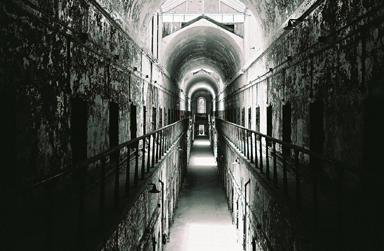
Eastern State Penitentiary


(c) 2005, m. wells

Eastern State Penitentiary, in the heart of Philadelphia, is a preservation project extraordinaire. Not only that, but it serves as haunted house, filming locale, art gallery, and an excellent Fourth of July diversion. I went there on the fourth with my friends from the Baltimore-area, punk-folk musician Kellee Webb, and Scott (Rooster) from Rooster and the Cocks of the Walk, a psychobilly band.

Anyway, the place is amazing, and highly recommended--especially for preservationists. Have a look, and see what greatness can occur when a building isn't messed with much, but left to decay as it would without intervention. The result is beautiful. It isn't an option for all preservation projects, but it certainly works for this building. I'm not sure what the ultimate intention is, but I hope that at least some wings are left as is, in the process of preservation.

They have made some interesting additions since the 1970s, when the building closed. These include the tidied and furnished cell that held Al Capone, complete with oil painting, desk and lamp, and more; a cell block where the original look of the front of the cells was recaptured (as a penitentiary, the prisoners originally had no contact--not even visual contact--with other prisoners); and a few cells which have been cleaned out and replastered, so that one can see what the place might have looked like when inhabited by regular prisoners.

They have also included art exhibits, which really add to the appeal of the place. If you can make it in time, don't miss the ghost cats. Also, the sound exhibit in one of the cell blocks is chilling. Also, various pipes lead the way to escape routes used over the years.

The building itself is pretty interesting. Opened in 1829, the principles of the building were radical. It called for complete isolation, and a panopticon design--both of which hindered escape, and were essential to futhering the Quaker philosophy of the place. The idea was to truly reform criminals, and to return them to society without anyone knowing they had been imprisoned. Also interesting was the inclusion of indoor plumbing--not just in some locations, but in every cell! The stories of Willie Sutton, Al Capone, the tunnel escape, the cat-inhabitants and much more, are told here. It's worth a trip.

Tuesday, August 09, 2005

Rio Sombrero


(c) 2005, m. wells

The last one in the Idaho Falls series (for now). This little row of storefronts was in perfect shape, each with its color-block of siding, and the neon design for the Rio, meant to be quite eye-catching. I wish I had taken a picture at night, actually--but I'm not entirely sure it would have been lit-up. Though the sign says "open," I didn't detect a lot of activity around the building.

Monday, August 08, 2005

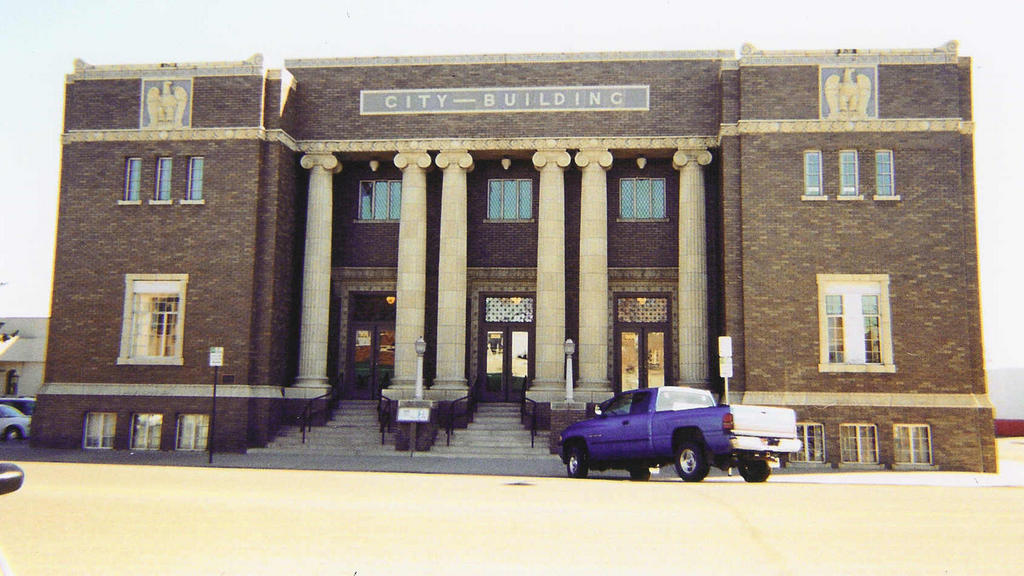
Idaho Falls City Building


(c) 2005, m.wells

The City-Building of Idaho Falls would look a lot bigger if that truck wasn't sitting there. The architect seems to have gone to great lengths to give the illusion of size--including the hefty columns, the tripartite design, and the dark brick. All undone.

Sunday, August 07, 2005

Nick's Trading Company and Lottery


(c) 2005, m. wells

One of the many older storefronts in downtown Idaho Falls. I especially like how "Nick's" is spelled with five different typefaces.

Saturday, August 06, 2005

Idaho Falls Downtown


(c) 2005, m. wells

Idaho Falls, readily identifiable from afar by the gleaming white spire of the Latter Day Saints Temple on the falls, is a small town that boomed in the early 1950s, due to the precursor of INL, the NRTS. NRTS, and Argonne National Laboratory-West brought scientific and engineering talent to the area, and created work in the Idaho desert. The people I met in Idaho Falls were modest about their small city, and particularly about their downtown, which admittedly was like many towns you see across the United States--but I liked it.

I set out early in the morning, crossed the falls from the Red Lion Hotel, walking towards the Museum of Idaho. There are about six intersections of interest in the downtown, and unless you're heading out to the strip for some shopping sprawl, everything is quite walkable. While many of the old storefronts are closed (including this Chinese restaurant, seen above) the bakeries and antique stores appear to get a lot of business. There is poverty and grit, as in all small cities, but I was pleased to see the local police force treating the homeless population with respect.

The downtown has perfectly preserved (probably by virtue of the fact that they have been empty all this time) its 1920s-1960s storefronts. There is a melange of style, from the more ornate eclectic period, to Moderne (that is, Art Deco in a more horizontal style), to the permastone and colored siding applied to buildings in the modern era. Some of these buildings, modified in the 1950s and 60s, are, I think, superior examples of the style. After all, as these modifications age, and no longer look contemporary, they are often dismantled. While they look bad to us now, we may regret the wholesale destruction of them later on. I will be posting a few photographs of these "modern" storefronts shortly.

At the edge of the downtown is a wide, dusty strip of railroad tracks (about six tracks, I think). Across the tracks is the Museum of Idaho, a partially historic, partially modern building which was previously a library. The nose of a aircraft is emerging from the modern structure, to announce the Space Exhibit currently on display.

Finally: the mystery of the low houses. On a drive around town, I saw two of a group of low houses--houses in which all the living space was below ground, and only the top of the house and the roofline was above ground. Unfortunately, I was not able to snap any pictures of these. I speculated that this might be some kind of natural disaster protection, but as local Bill Ginkel told me, the explanation is much simpler. When people moved to Idaho Falls in the 50s, they bought land and started to build their houses. Often, the money they had was only enough to build the basement, and in order to make it through the year, presumably, a roof had to be put on the half-built house. Some of these houses were never finished, and remain basement houses. The story reminded me of the garage houses in Chicago.

Friday, August 05, 2005

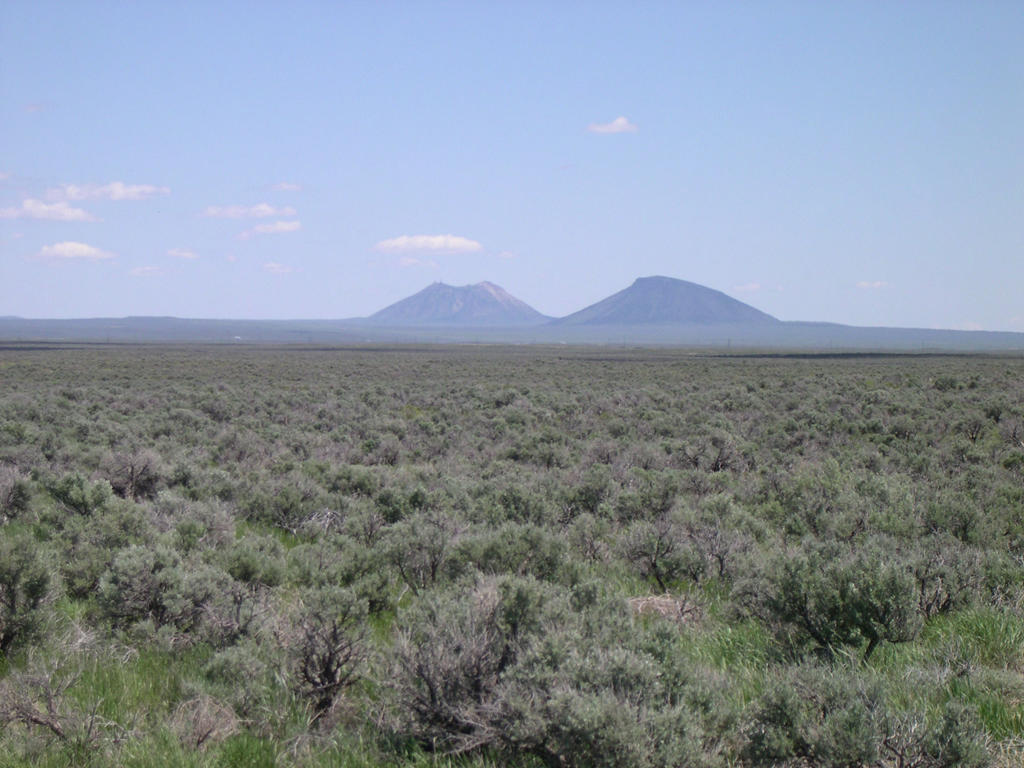
Idaho Falls and surrounding desert


Two buttes near the Experimental Breeder Reactor I on the INL campus, as seen in April. I was out in Idaho for the opening of the Race for Atomic Power exhibit at the Museum of Idaho, with AHF, Academy Studios, and many others. Robert from AS and I wanted to hijack the car and go up to Craters of the Moon (only about 80 miles, I think), but no time for that. There is some great hiking and animal spotting in the nearby area. Just on the drive up to EBR-I, I saw two pronghorn and a coyote. Check out the Museum of Idaho if you get a chance.

Wednesday, August 03, 2005

Oakland, California


(c) photograph by m. wells


This photograph was taken in 2002, near downtown Oakland, very close to the Fruitvale BART Station. The building was not being torn down in its entirety, but modified from its former life as a commercial-industrial structure, to a new one as loft housing for the growing Bay Area population. Still, seeing the building like this, with rebar and concrete everywhere, seems a little sad, nonetheless.

Tuesday, August 02, 2005

Robert E. Lee Motel


(c) photograph by m. wells


Somewhere between Bristol, Tennessee, and Abingdon, Virginia, stands the Robert E. Lee Motel. Back in the summer of 2001, I and my car made a series of trips around this area. It was before I was a preservationist, but the seeds of it were in me: history, art, architecture, and storytelling.

My friends gave me exceedingly complex directions to backcountry locations. One of these was a junkyard, seemingly abandoned. Cars from the 30s, 40s, and 50s were sinking into the soft earth here, only their headlights visible from the road through the thick brush and Virginia Creeper. My search for the perfect grille was abruptly ended by an adrenaline-inducing chase though the forest by junkyard dogs and a man in a blue pickup truck. On another backcountry trip, I encountered a revival in yellow and white striped tents.

In the case of the Lee Motel, I was armed with only one thing--the camera. I came to an abrupt stop at a gas station across the road from this fetching Moderne motel. If only it had been night-time, and the place had been open: the neon sign would have been lit, and so enticing. But it was not open, and it was heavily overgrown. Some of the plants had come in at the windows, and through cracks in the structure and pavement. A man at the gas pump was watching me. I could hardly try and slip through the windows, or around back without rousing some suspicion. But I snapped this picture, and I still remember the crickets humming.

Monday, August 01, 2005

Lowenthal on Heritage Sites

I’ve been thinking about David Lowenthal’s chapter in Giving Preservation a History, “The Heritage Crusade and its Contradictions.” I find the chapter to be a little incendiary, considering that Lowenthal is writing to an audience of preservationists, and he himself has been working with heritage sites, most recently with ICOMOS. Still, a little professional unease is good--it means that we’re thinking critically about our work.

He was, I think, on the mark to say that the American obsession with heritage is a little out of control—and he means heritage in the broadest sense, from founding fathers and battlegrounds to baseball cards and lunch boxes. Heritage has grown to encompass all that is past, trivial or grandiose.

Interestingly, he notes that this kind of heritage--heritage as a physical manifestation--is particular to Western countries. He talks a little about Asia, and specifically China, in illustration of this. I was interested in this, in light of the Historic Preservation Department’s recent trip to China, and I wonder if this ever came up in discussion, either during the trip, or afterwards. Citing Wang Gungwu and Pierre Ryckmans (and others), Lowenthal writes that heritage in Asia is best understood through living tradition--creative skills, art, letters, memory—and not through remains or monuments. This does fit with my impressions of the intellectual history of China in the past century and a half, and while monuments and sites may be destroyed there (and they have) it is less easy to erase traditional thought and practice. In the end, this may have been looked to for its essential Chineseness.

But it seems that the Western notion of heritage is spreading too, since the proliferation of monuments and heritage sites is occurring abroad as well as at home.

There is something to the heritage movement, in all its forms, that makes sense to me (besides its creation of work for me to do). Durkheim once wrote that socialism was “a cry of pain,” rather than a political movement. Heritage, too, perhaps. While heritage is not a directly opposite reaction to rampant capitalism and the discomfort it causes, neither can it be seen as in line with capitalism, philosophically. I can easily see how heritage could be an emotional response to a real threat--to anything that doesn’t constitute the highest and best use of your little chunk of property.

It is one thing to say that we don’t need a glut of old material (be it buildings, excess paper at archives, or a never-ending supply of collector’s items) and that there ought to be room for innovation. It is another to ask that we take losses in the way of historical remains, and get neither innovation nor beauty in return--but things which were not intended to last and which do not make us very happy.

Lowenthal suggests, all too briefly, that we might turn our efforts to preserving our traditional creative skills, our cultural and intellectual tradition, and of course, memory. All of this is fine, of course, but none of these things serves well as currency, and as a result, they aren’t always valued. Real estate does, and is.