
David Hollinger's Postethnic America seemed an appropriate follow-up to the last reading, as the two works reference one another, and Hollinger's idea appears to flow quite naturally from the [Roediger's] idea of "whiteness studies," which documents how varied European and Middle-eastern "races" came to be considered generically white (only sometimes, as I pointed out before). Hollinger's book is more fascinating reading (shall I say more provocative?) than Roediger's--for an experienced historian. While presumably Roediger is writing to a lay audience, Hollinger is writing to a community of historians, sociologists and ethnographers, in a work that straddles the boundaries of historiography and sociology.
The first part of the book, already 14 years old, covers some familiar ground, though the way he writes it is more interesting. For example, as he talks about Americans' conscious and unconscious choices of "ethno-racial blocs" he writes that Alex Haley's choice (to seek out his African roots as opposed to his Irish ones) is no choice at all--although I think in the intervening years between Roots and now, Haley's choice has become a significantly more real one. Hollinger also (thankfully) talks a little about the different perceptions of ethnicity from the distinctly racial pentagon to a more complex and detailed approach. While it's true that in some situations, people from one "ethno-racial bloc" will not notice or care about the finer distinctions in another, I happen to think no sensitive or intelligent person would fail to try. Do I care about the difference between Dominican and Puerto Rican? Of course! Or about Abenaki vs. Miwok? Sure!
What really grabs you in this book is Hollinger's attempt to trace multiculturalism from its roots (emerging somewhat oddly out of post WWII universalist perspectives) to current (mid-90s) academic infighting about how we should understand or express our multiculturalism, having eschewed ethnocentrism and universalism almost completely. He outlines the universalist concept, and then the emerging "paradigmatic" concept of history (creating a huge objectivity question in the field) and then the beginnings of multiculturalism, coinciding perhaps, with relativism. Hollinger tracks Richard Rorty's progression through stages and incarnations of multiculturalism through to the '90s, effectively showing the sometimes comical twists and turns of the academic perspective as we try to do the right thing by our multiple cultures.
Universalism, the new multiculturalists wrote, was a manifestation of our own Western (and possibly even American) ethnocentrist perspective, and therefore even the hopeful remarks about being one human family that shares the same struggles and emotions are, in fact, false. This led, in the extreme case, to historians, anthropologists and others taking the opposite view--and concluding that we cannot impose our Western/Judeo-Christian ideas of human rights on other cultures. Taken to its full extreme, it creates ethical problems for those of us concerned with the health and quality of life of other human beings, to say nothing of liberty (which, while perhaps a Western idea, has over 5000 years of historical strength as a desired state of being.)
Complicating matters are the cosmopolitan and the pluralist movements before and around multiculturalism, which ask the question, "how do we determine the many groups which are either making up the whole, or which continue to be un-unified parts?" Hollinger's idea of a postethnic society is one where all categories, layers and aspects of identity are in question--and given equal weight. "Consciously and critically locating oneself amid these layers," where everyone has a choice as to how they identify themselves, and without external identification. Rather than wanting to eliminate ethno-identity, Hollinger hopes that ethnicity can be boundary-less, multifaceted, and part of a much larger and more complex picture. Interestingly, this has some of the positive aspects of universalism, combined with a modern interpretation of the cultural pluralist thread.
Hollinger addresses the potential problems innate in the pursuit of a postethnic world, fairly eloquently, and a 2000 postscript was added, tracking some of the changes in thought about multiculturalism and the US at the end of the century. I think--I think!--that in the last nine years, America has made that much more progress towards a non-racial perspective--not because of policy changes, different phrasing of census questions, changes in affirmative action, or anything else like this--but simply because the composition of the United States is changing. The number of "mixed" relationships and blended backgrounds, families with multiple ancestral origins, adoptions outside a specific group, and people who choose to be affiliated with groups that they have little or no blood-tie to--all these are areas of growth. If we continue to silence the undercurrent of hate (which does exist, sadly) perhaps in time that too will fade, like an unused, vestigial organ.
Wednesday, July 29, 2009

Tuesday, July 21, 2009
Readings: Roediger and Ehrenreich
I started my summer readings with a rereading of Novick's That Noble Dream, and first readings of David Roediger's Working Toward Whiteness, with a brief detour into Barbara Ehrenreich's Nickel and Dimed (not on the list, but which my mom was perusing for readings for her social justice class in the fall). Technically, another similarly titled Roediger book was on the list, but this was the one available here. Novick is an outlier and deserving of a full post so I will skip him for now. However, I was intrigued by the single blurb on the cover of Roediger's book, supplied by the Washington Post, "provocative." Well, I didn't find it terribly provocative--how's that for a provocative statement?
This doesn't mean I didn't find it a competent and readable history. It was. However, the concept of "whiteness studies" as a way of breaking the prevailing understanding of whiteness as a "norm," and the journey of Southern and Eastern European immigrants from "dark white" to "white" is not new to me. As a Californian, maybe, and a product of a parent and an historical moment concerned with ethnic origins, the sheer diversity within the category "white" has long been quite evident to me, and the origins and arrival times of various ethnic groups, along with the difficulties they faced--these stories have been with me since childhood. On top of European ethnic groups, California is also home to many Asian and South Asian ethnicities, "Black," African and Carribean ethnicities, and several indigenous groups as well. In the 70s and 80s, there was a lot of "roots" searching, and this phenomenon trickled down to schooling.
Added to this, I'm also aware that we're not living in a post-ethnic society for those deemed "white." While, on a form, a Croatian-, an Italian-, and an Irish-American may all select "white," that doesn't mean that there aren't people out there calling them "guinea," "mick" and who knows what else. There are. I've met them. And there are plenty of folks who still equate "Jew" with race or ethnicity, even though I do my best to make it clear that Judaism is a religion, and I feel strongly that that there are no "ethnic" Jews. And these things equate to a mild (or not so mild) racism, even if your term of choice is "ethnic." Some evidence (in an amusing and palatable form) can be seen in Gilbert Hernandez's comic Love and Rockets: A Rock 'n' Roll Headache from '89.
So you see it's not that I disagree with the premise of the book--Roediger is on the mark when he's speaking historically about transformations in ethnic groups arriving and living in America, and the parallel path of African-Americans, who did not have the benefit of being able to change race. But I would argue that only in some settings have certain groups effectively changed race. Another point that Roediger discusses, though it's not his main point, is the arbitrariness of the term "race." As I understand it, it is an unscientific term at best, and at worst it is a manipulation of perception. Percival Everett puts this quite well in Erasure when the character Monk talks about why society has deemed him "Black." If I felt an historical evaluation of the term "race" was the primary point of the book, and if it were written in the style of Frantz Fanon, then perhaps I would have called it "provocative."
Ehrenreich's book I also had ambivalent feelings about. I realize I am a late reader, but I'm sure it remains on reading lists everywhere. On one hand, it is an important bit of investigation, showing not only the near impossibility of rising out of the mire of minimum wage employment, and revealing the poor quality of life so many people have who are effectively "passing" for middle class. However, I felt a bit wary of someone who dips into blue collar life for a month or two, being myself someone who has been living a real honest-to-goodness blue collar life. And as my mom and I were talking about the book, we were both taken aback by some of Ehrenreich's own prejudices--she comes across as ageist, insensitive about Alzheimers patients (oddly, I thought) and at times irritatingly judgmental of people around her (which I noted that she sometimes admits to, in the writing).
We agreed that she's firmly within her own head, which makes this different from an ethnographer, or an historian, a novelist, or Studs Terkel--all of whom either make an attempt to be in someone else's head, or take the materials back to the subjects and say, "these were my impressions--am I on the mark?" There was a queer absence of follow-up with her coworkers--and I say this with the conviction that my coworkers will be lifelong friends, if they want it. At any rate, I'm sure that this book has raised some consciousnesses. But I wonder how many, as we struggle onward in the rising waters of low wages, unemployment, high rents, and outsourcing of jobs and industry to countries where we can exploit labor legally for peanuts.
This doesn't mean I didn't find it a competent and readable history. It was. However, the concept of "whiteness studies" as a way of breaking the prevailing understanding of whiteness as a "norm," and the journey of Southern and Eastern European immigrants from "dark white" to "white" is not new to me. As a Californian, maybe, and a product of a parent and an historical moment concerned with ethnic origins, the sheer diversity within the category "white" has long been quite evident to me, and the origins and arrival times of various ethnic groups, along with the difficulties they faced--these stories have been with me since childhood. On top of European ethnic groups, California is also home to many Asian and South Asian ethnicities, "Black," African and Carribean ethnicities, and several indigenous groups as well. In the 70s and 80s, there was a lot of "roots" searching, and this phenomenon trickled down to schooling.
Added to this, I'm also aware that we're not living in a post-ethnic society for those deemed "white." While, on a form, a Croatian-, an Italian-, and an Irish-American may all select "white," that doesn't mean that there aren't people out there calling them "guinea," "mick" and who knows what else. There are. I've met them. And there are plenty of folks who still equate "Jew" with race or ethnicity, even though I do my best to make it clear that Judaism is a religion, and I feel strongly that that there are no "ethnic" Jews. And these things equate to a mild (or not so mild) racism, even if your term of choice is "ethnic." Some evidence (in an amusing and palatable form) can be seen in Gilbert Hernandez's comic Love and Rockets: A Rock 'n' Roll Headache from '89.
So you see it's not that I disagree with the premise of the book--Roediger is on the mark when he's speaking historically about transformations in ethnic groups arriving and living in America, and the parallel path of African-Americans, who did not have the benefit of being able to change race. But I would argue that only in some settings have certain groups effectively changed race. Another point that Roediger discusses, though it's not his main point, is the arbitrariness of the term "race." As I understand it, it is an unscientific term at best, and at worst it is a manipulation of perception. Percival Everett puts this quite well in Erasure when the character Monk talks about why society has deemed him "Black." If I felt an historical evaluation of the term "race" was the primary point of the book, and if it were written in the style of Frantz Fanon, then perhaps I would have called it "provocative."
Ehrenreich's book I also had ambivalent feelings about. I realize I am a late reader, but I'm sure it remains on reading lists everywhere. On one hand, it is an important bit of investigation, showing not only the near impossibility of rising out of the mire of minimum wage employment, and revealing the poor quality of life so many people have who are effectively "passing" for middle class. However, I felt a bit wary of someone who dips into blue collar life for a month or two, being myself someone who has been living a real honest-to-goodness blue collar life. And as my mom and I were talking about the book, we were both taken aback by some of Ehrenreich's own prejudices--she comes across as ageist, insensitive about Alzheimers patients (oddly, I thought) and at times irritatingly judgmental of people around her (which I noted that she sometimes admits to, in the writing).
We agreed that she's firmly within her own head, which makes this different from an ethnographer, or an historian, a novelist, or Studs Terkel--all of whom either make an attempt to be in someone else's head, or take the materials back to the subjects and say, "these were my impressions--am I on the mark?" There was a queer absence of follow-up with her coworkers--and I say this with the conviction that my coworkers will be lifelong friends, if they want it. At any rate, I'm sure that this book has raised some consciousnesses. But I wonder how many, as we struggle onward in the rising waters of low wages, unemployment, high rents, and outsourcing of jobs and industry to countries where we can exploit labor legally for peanuts.
Sunday, July 19, 2009
Apocalyptic dreams
Okay, in the first I believe I was in a city--maybe Chicago, but not resembling any city I've actually visited. I guess I was there with my mom--maybe for a conference. At some point, I needed some item and headed for a big-box store (I don't know, maybe Wal-Mart--not because I ever go there, but because we were talking about it yesterday.) While looking for the item, I ran into 恺, and we talked for a minute, and then I saw John K., and we were talking when a large blast shattered the huge windows at the front of the store, and icy gusts of rain and hail were blowing in. I stood there for a minute in wonder, but not really thinking about the cause. At that moment, for me, it was just an isolated incident. And then I realized that this was a symptom of something much bigger. Perhaps a terrific storm that was going to destroy everything in its wake. John screamed (sorry John, just a dream) and I grabbed his hand and we ran for a bit--away--and when I looked at my cell-phone there was no service.
We stopped somewhere safe (I'm sure there were lots of people milling about in confusion still) and I pulled out a map, and we were looking at these territories (which I can't now name, but it was not local counties or states or anything recognizable). John and I talked about which place would be the safest to travel to, and then I realized I had a cell signal again, and I either called or received a call from mom, which said she would meet us at the hotel. She seemed less alarmed, and I said to John, I guess you can come with me to the hotel, or head on by yourself. And then I woke up, briefly.
When I fell back asleep, I dreamed I was wandering around some town or city, doing something innocuous, when I saw a group of goggled people leaving a theater, and I followed them. They seemed to be in varying stages of blindness, or something similar, and they seemed to be moving under duress. Somehow I became part of the group--and part of a subgroup of new people. The new people were not yet blind. We arrived at what I perceived as a prison/dormitory made from a converted building of some other type. The place itself was not unpleasant, but the imprisonment or internment was clear, as was I guess the hopelessness for the future. I saw everyone else getting settled in their rooms, and then I found 'mine;' it was not in my name, but someone else's. And then I woke up
We stopped somewhere safe (I'm sure there were lots of people milling about in confusion still) and I pulled out a map, and we were looking at these territories (which I can't now name, but it was not local counties or states or anything recognizable). John and I talked about which place would be the safest to travel to, and then I realized I had a cell signal again, and I either called or received a call from mom, which said she would meet us at the hotel. She seemed less alarmed, and I said to John, I guess you can come with me to the hotel, or head on by yourself. And then I woke up, briefly.
When I fell back asleep, I dreamed I was wandering around some town or city, doing something innocuous, when I saw a group of goggled people leaving a theater, and I followed them. They seemed to be in varying stages of blindness, or something similar, and they seemed to be moving under duress. Somehow I became part of the group--and part of a subgroup of new people. The new people were not yet blind. We arrived at what I perceived as a prison/dormitory made from a converted building of some other type. The place itself was not unpleasant, but the imprisonment or internment was clear, as was I guess the hopelessness for the future. I saw everyone else getting settled in their rooms, and then I found 'mine;' it was not in my name, but someone else's. And then I woke up
Sunday, July 05, 2009
Uncle Silas and Cambodia
Well, I got sacked again! Not enough work. But this leaves me some extra time to fix the house, which is slowly getting improved for sale: new tile in the bathroom, new light fixtures inside and out, stained cabinetry and ceiling trim, finished tin ceiling, repainting, new cabinet handles, plants weeded, etc... Also, I'm getting a lot of non-required reading done now, as I imagine my fall reading will be a combination of histories, historiography and student papers.
The two I just finished are in no way connected. Uncle Silas is a Victorian gothic thriller (not really a 'mystery,' as it is billed) by J. Sheridan LeFanu. And Cambodia: A book for people who find television too slow, by Brian Fawcett, is a work of 'fiction' which reads like a combination of personal essay and social commentary. I enjoyed Silas, but I fell in love with Cambodia.
Uncle Silas is very much in the vein of Ann Radcliffe's work, such as The Mysteries of Udolpho, and in fact the main character Maud mentions Radcliffe more than once. However, LeFanu is not prone to writing endless descriptions of the Pyrenees or inserting three pages of poetry, and so the work is 400 pages instead of 800 pages. LeFanu also jumps right into the mystery--but perhaps this is because 1860s readers had slightly less need of books that lasted through the entire winter months as perhaps Radcliffe's readers in the 1790s had need of? However, Radcliffe is more realistic in her portrayal of courtship, I think, and her scenes at Udolpho (with Count Montoni) are quite compelling--whereas the estate at Bartram-Haugh (and Silas himself) never reach the same level of hatefulness. It drove me nuts waiting for Emily to escape, but I didn't feel the same urgency for Maud until the very end.
One interesting character, Milly, is a new one to me: a young (16-18) lady of the upper classes who has been so neglected in her childhood that she has read nothing, speaks like a 'dairy-maid' and runs freely around the estate, giving people cheeky nicknames and trespassing on neighboring properties. Some of the characters in Uncle Silas are followers of Swedenborg, and while I originally got the feeling that this was supposed to cast suspicion upon them, in fact (luckily for Swedenborgians) both Bryerly and Austin Ruthyn are blameless in the novel. I'd say this is a great book to read beside the fireplace in the dead of winter, with a cup of hot chocolate and a kitty on your lap.
And Cambodia: A book for people who find television too slow, by the Canadian author Fawcett, was totally unexpected. First of all, it changed the way I define fiction. Fawcett's stories combine the essay form, history, commentary on recent news and events, conversations with dead people, speculations or hypothetical situations, detailed explanations of the mundane functions of bureaucracy, conversations with friends and personal experiences. And they are incredibly compelling, sometimes funny, and often chilling. And on the bottom third of every page in a smaller font is an essay about Cambodia (written around 1985 about the events, mostly post-Vietnam, leading up to the Khmer Rouge regime, the Khmer Rouge, and then the subsequent Vietnamese invasion--and also about the western response and portrayal of these events.)
At the very beginning and throughout, Fawcett is suspicious of, and maybe disdainful of 'subtext,' the 'global village' and other such burgeoning concepts of the '80s. He writes about the inherent divisions between the academic 'in the know' and all others, and the growing loss of personal political involvement, the uselessness of the bureaucratic decision-making process, the lack of national memory for events like the Kent State protest/shooting, and the way globalization (perhaps in its current/capitalist form) is detrimental to many (most?). And what I assume are some personal details sneak their way in... in "The Fat Family Visits the Fair," his friend Howard (to all appearances a real person) ends up 'creating' the (non-existent) Cambodia pavilion at the World's Fair, and subsequently commits suicide. And the abruptness and reality of it hit me like a sandbag. I was knocked over.
If this is fiction--and he says it is--have I been playing it wrong. And I thought: where has this been?--why haven't I seen this before? I can't sit here and describe the stories. They pack a much better punch when you just read them. So, just read them!

Rice farmers (mew)
The two I just finished are in no way connected. Uncle Silas is a Victorian gothic thriller (not really a 'mystery,' as it is billed) by J. Sheridan LeFanu. And Cambodia: A book for people who find television too slow, by Brian Fawcett, is a work of 'fiction' which reads like a combination of personal essay and social commentary. I enjoyed Silas, but I fell in love with Cambodia.
Uncle Silas is very much in the vein of Ann Radcliffe's work, such as The Mysteries of Udolpho, and in fact the main character Maud mentions Radcliffe more than once. However, LeFanu is not prone to writing endless descriptions of the Pyrenees or inserting three pages of poetry, and so the work is 400 pages instead of 800 pages. LeFanu also jumps right into the mystery--but perhaps this is because 1860s readers had slightly less need of books that lasted through the entire winter months as perhaps Radcliffe's readers in the 1790s had need of? However, Radcliffe is more realistic in her portrayal of courtship, I think, and her scenes at Udolpho (with Count Montoni) are quite compelling--whereas the estate at Bartram-Haugh (and Silas himself) never reach the same level of hatefulness. It drove me nuts waiting for Emily to escape, but I didn't feel the same urgency for Maud until the very end.
One interesting character, Milly, is a new one to me: a young (16-18) lady of the upper classes who has been so neglected in her childhood that she has read nothing, speaks like a 'dairy-maid' and runs freely around the estate, giving people cheeky nicknames and trespassing on neighboring properties. Some of the characters in Uncle Silas are followers of Swedenborg, and while I originally got the feeling that this was supposed to cast suspicion upon them, in fact (luckily for Swedenborgians) both Bryerly and Austin Ruthyn are blameless in the novel. I'd say this is a great book to read beside the fireplace in the dead of winter, with a cup of hot chocolate and a kitty on your lap.
And Cambodia: A book for people who find television too slow, by the Canadian author Fawcett, was totally unexpected. First of all, it changed the way I define fiction. Fawcett's stories combine the essay form, history, commentary on recent news and events, conversations with dead people, speculations or hypothetical situations, detailed explanations of the mundane functions of bureaucracy, conversations with friends and personal experiences. And they are incredibly compelling, sometimes funny, and often chilling. And on the bottom third of every page in a smaller font is an essay about Cambodia (written around 1985 about the events, mostly post-Vietnam, leading up to the Khmer Rouge regime, the Khmer Rouge, and then the subsequent Vietnamese invasion--and also about the western response and portrayal of these events.)
At the very beginning and throughout, Fawcett is suspicious of, and maybe disdainful of 'subtext,' the 'global village' and other such burgeoning concepts of the '80s. He writes about the inherent divisions between the academic 'in the know' and all others, and the growing loss of personal political involvement, the uselessness of the bureaucratic decision-making process, the lack of national memory for events like the Kent State protest/shooting, and the way globalization (perhaps in its current/capitalist form) is detrimental to many (most?). And what I assume are some personal details sneak their way in... in "The Fat Family Visits the Fair," his friend Howard (to all appearances a real person) ends up 'creating' the (non-existent) Cambodia pavilion at the World's Fair, and subsequently commits suicide. And the abruptness and reality of it hit me like a sandbag. I was knocked over.
If this is fiction--and he says it is--have I been playing it wrong. And I thought: where has this been?--why haven't I seen this before? I can't sit here and describe the stories. They pack a much better punch when you just read them. So, just read them!
Rice farmers (mew)
Sunday, June 28, 2009
West, punch list
There is a tenuous connection between my work story this week and Morris West's The Devil's Advocate, but since I want to talk about both, I will go ahead and make it. My workweek was half spent helping Mark Judge rock and tile my bathroom with subway tile, and half spent at the Naylor & Breen jobsite building "affordable" housing.
There are a lot of new guys on the jobsite, which is on the border of Winooski and Colchester, but Russ, Pat and Jimmy are holdovers from the old days of LWB, and Pat had only just arrived on site fresh from working with Doug in Cambridge. Of course, they three were happy to see me, and I them. My role is punch list (post stair installation--meaning kneewalls, soffits and handrail blocking) as well as cutting the notched stair stringers. Aside from the suspicious site supervisor (always), there was much laughter. Pat says (about a comment he just made), "no, that's not where I want to be when Jesus comes back!" Russ says, "I want to burn one with Miriam one day," and Jimmy confides in me about his wage being dropped $3 an hour. I feel as if these guys are my brothers.
And then there's Ben. Ben holds himself apart--not, I think, because he's the boss, but because he can't relate. After all, Doug (Ben's business partner) revels in earthy dialogue. But one very hot day last week, I went up to Ben's truck at lunch to ask a question, and he was hunched over, soaking his head and everything else with a bottle of water (he'd been up on the second floor deck setting walls with a crane). It seemed a very solitary and even private moment, and I'd almost not wanted to intrude. Later, Pat and I were sitting in the back of the Subaru laughing, and I (we?) were also watching Ben alone 50 feet away. When I first started working with him three years ago, I thought that he spent so little time talking with me about Japan, or Graham Greene, because he didn't want to cultivate that image in front of the rest of the crew--but now I see that it's not only that. I enjoy everyone (almost everyone) on the jobsite, on some level, and hearing them talk, well, it's like Studs Terkel's 'vox humana.'
And I remembered, in The Devil's Advocate, Meredith ruminates on this: "Other priests, he knew, found an intense pleasure in the raw, salty dialect of peasant conversation. They picked up pearls of wisdom and experience over a farmhouse table or a cup of wine in a workman's kitchen. They talked with equal familiarity to the rough tongued whores of Trastevere and the polished signori of Parioli ... They were good priests, too, and they did much for their people, with a singular satisfaction to themselves."
I like this novel very much, as I did Shoes of the Fisherman and Eminence, though it is a good deal older than those two Varican novels. In a way, it sets the precedent for them (and also the formula), but was written before Vatican II and the reforms of John XXIII. It's interesting to make a comparison of these three, because (in West's inimitable formula!) each main character undergoes a great personal transformation assisted by an impossibly ideal friendship (often between two unequal in rank) and in which the personal transformation has effects which reach into the personal lives of other characters in the novels, mostly for good. West is a Christian believer's author, where Greene is a Christian doubter's author.
Some elements of this 1959 work are surprising to me: West's rather sensitive portrayal of homosexuality (which gets even more sensitive in the more modern works) and his rather interesting portrait of the similarities and friendships between Jews and Catholics--a relationship I feel exists, but is often ignored. And West usually includes a man whose character is too beautiful to believe, but who the reader can't help but love: in this, it's Aurelio, the bishop of Valenta. Aurelio is the gentle push that sends Meredith into a renewed, if short life working as 'promoter of the faith' in a sainthood investigation.
Aurelio's suggestion to Meredith to carry a flask of grappa, and sweets, to Gemello Minore, brings me back, full circle, to work, and what it means to sit and listen and take part in conversation with people who live very different lives than me, to be as their sister, to be part of the human family.

Spooky Philadelphia (mew)
There are a lot of new guys on the jobsite, which is on the border of Winooski and Colchester, but Russ, Pat and Jimmy are holdovers from the old days of LWB, and Pat had only just arrived on site fresh from working with Doug in Cambridge. Of course, they three were happy to see me, and I them. My role is punch list (post stair installation--meaning kneewalls, soffits and handrail blocking) as well as cutting the notched stair stringers. Aside from the suspicious site supervisor (always), there was much laughter. Pat says (about a comment he just made), "no, that's not where I want to be when Jesus comes back!" Russ says, "I want to burn one with Miriam one day," and Jimmy confides in me about his wage being dropped $3 an hour. I feel as if these guys are my brothers.
And then there's Ben. Ben holds himself apart--not, I think, because he's the boss, but because he can't relate. After all, Doug (Ben's business partner) revels in earthy dialogue. But one very hot day last week, I went up to Ben's truck at lunch to ask a question, and he was hunched over, soaking his head and everything else with a bottle of water (he'd been up on the second floor deck setting walls with a crane). It seemed a very solitary and even private moment, and I'd almost not wanted to intrude. Later, Pat and I were sitting in the back of the Subaru laughing, and I (we?) were also watching Ben alone 50 feet away. When I first started working with him three years ago, I thought that he spent so little time talking with me about Japan, or Graham Greene, because he didn't want to cultivate that image in front of the rest of the crew--but now I see that it's not only that. I enjoy everyone (almost everyone) on the jobsite, on some level, and hearing them talk, well, it's like Studs Terkel's 'vox humana.'
And I remembered, in The Devil's Advocate, Meredith ruminates on this: "Other priests, he knew, found an intense pleasure in the raw, salty dialect of peasant conversation. They picked up pearls of wisdom and experience over a farmhouse table or a cup of wine in a workman's kitchen. They talked with equal familiarity to the rough tongued whores of Trastevere and the polished signori of Parioli ... They were good priests, too, and they did much for their people, with a singular satisfaction to themselves."
I like this novel very much, as I did Shoes of the Fisherman and Eminence, though it is a good deal older than those two Varican novels. In a way, it sets the precedent for them (and also the formula), but was written before Vatican II and the reforms of John XXIII. It's interesting to make a comparison of these three, because (in West's inimitable formula!) each main character undergoes a great personal transformation assisted by an impossibly ideal friendship (often between two unequal in rank) and in which the personal transformation has effects which reach into the personal lives of other characters in the novels, mostly for good. West is a Christian believer's author, where Greene is a Christian doubter's author.
Some elements of this 1959 work are surprising to me: West's rather sensitive portrayal of homosexuality (which gets even more sensitive in the more modern works) and his rather interesting portrait of the similarities and friendships between Jews and Catholics--a relationship I feel exists, but is often ignored. And West usually includes a man whose character is too beautiful to believe, but who the reader can't help but love: in this, it's Aurelio, the bishop of Valenta. Aurelio is the gentle push that sends Meredith into a renewed, if short life working as 'promoter of the faith' in a sainthood investigation.
Aurelio's suggestion to Meredith to carry a flask of grappa, and sweets, to Gemello Minore, brings me back, full circle, to work, and what it means to sit and listen and take part in conversation with people who live very different lives than me, to be as their sister, to be part of the human family.

Spooky Philadelphia (mew)
Tuesday, June 23, 2009
Sammler's Planet
I read my first Bellow some months ago--Henderson the Rain King. I suppose I liked bits of it, but the general effect on me was this sort of painful embarrassment and so I left off somewhere around page 100 with the feeling of impending humorous doom, and read the last five pages or so, which left me rather unsatisfied about what had transpired. After all, it is not a Mike Hammer mystery with the killer revealed on the last page. But anyway, I just couldn't concentrate on finishing the book, and moved on.
While I was in Chicago I stopped by the Old Neighborhood, and by Unabridged Books. They have a rather large Penguin collection, and I found Mr. Sammler's Planet, and encouraged by the description, I bought it. I did, after all, need something to read on the trip back. This book, too had a similar point-of-no-continuing for me (somewhere in the 80s, I think) but I persisted onward this time. I think (before I get down to the novel itself) that Saul Bellow's ideas appeal to me, but I find the particular way he executes them tiresome.
Mr. Sammler's Planet is about an academic--a Holocaust survivor too--in what must have seemed like a tumultuous 1970. The plot defies explanation (perhaps to Sammler's satisfaction: early in the novel he disparages the culture of explanation). Also, interestingly, this character Sammler seems like he might be an approximation of Bellow himself. I wondered, as the book's narrative snakes in and out of Sammler's long reveries, if these thoughts are the thoughts Bellow was having as he travelled through the city, observed its inhabitants, interacted with his friends and family. But, I realize this is too easy an assumption to make. At any rate, Sammler is less than capable of human feeling (compassion, maybe), though he approximates it. The book takes him through a series of historical events in his own life (and outside it) and through modern life of 1970, introducing us to his remaining family and his friends and benefactors. They are all subject to Sammler's silent and scathing criticism, though he appears to love them too. Modern life though--or modern thought--distresses, angers, unnerves, makes no sense to him. He is particularly concerned with sexual paradigm, and with the emphasis on individuality (as demonstrated in psychotherapy, clothing, the increased interest in cultural ancestry, art, etc.) which he perceives as self-serving behavior.
Oddly, Sammler's main complaint with one of his more likable family-members, Margotte, is that she talks on and on about theoretical subjects--which Sammler himself does even more often--which suggests what he lacks is not exactly compassion, but insight. He has also (in the search for a common? old world? civilized? existence) forsaken emotion, humor, sentimentality ("a man who looks upon all mortal foolishness with hostile condescension," writes Stanley Crouch). It is arguable what exactly happens... I suspect the events that take place as his friend Elya nears death (the assault on the pickpocket, the incident with Govinda Lal's manuscript, his daughter's mental illness and Elya's children's shortcomings) are like small steps toward humanity for Sammler. It occurs to me, as it may have to others, that a survivor of attempted genocide would find compassion a difficult, maybe foreign emotion, just as Holocaust survivors often renounced faith. Sammler reluctantly and irritably believes in God, because he cannot conceive the absence of God, but instead he has renounced humanity--and then returned to it.
One of the most fascinating and encouraging things about this novel was reading Sammler's thoughts: untruncated, difficult, far-reaching and diverse. The thoughts are tenuously connected, but attaching and detaching themselves like electrons to a molecule, or like brief connections between neurons. History, philosophy and science tied together with the lightest of strings, like a web--I loved the speed of the connections. Not stream-of-consciousness, but a consciousness accurately described in writing. This book does not end neatly--just as it does not read neatly. However, it is strangely and touchingly, multifacetedly human.

Guard goat, Milton (mew)
While I was in Chicago I stopped by the Old Neighborhood, and by Unabridged Books. They have a rather large Penguin collection, and I found Mr. Sammler's Planet, and encouraged by the description, I bought it. I did, after all, need something to read on the trip back. This book, too had a similar point-of-no-continuing for me (somewhere in the 80s, I think) but I persisted onward this time. I think (before I get down to the novel itself) that Saul Bellow's ideas appeal to me, but I find the particular way he executes them tiresome.
Mr. Sammler's Planet is about an academic--a Holocaust survivor too--in what must have seemed like a tumultuous 1970. The plot defies explanation (perhaps to Sammler's satisfaction: early in the novel he disparages the culture of explanation). Also, interestingly, this character Sammler seems like he might be an approximation of Bellow himself. I wondered, as the book's narrative snakes in and out of Sammler's long reveries, if these thoughts are the thoughts Bellow was having as he travelled through the city, observed its inhabitants, interacted with his friends and family. But, I realize this is too easy an assumption to make. At any rate, Sammler is less than capable of human feeling (compassion, maybe), though he approximates it. The book takes him through a series of historical events in his own life (and outside it) and through modern life of 1970, introducing us to his remaining family and his friends and benefactors. They are all subject to Sammler's silent and scathing criticism, though he appears to love them too. Modern life though--or modern thought--distresses, angers, unnerves, makes no sense to him. He is particularly concerned with sexual paradigm, and with the emphasis on individuality (as demonstrated in psychotherapy, clothing, the increased interest in cultural ancestry, art, etc.) which he perceives as self-serving behavior.
Oddly, Sammler's main complaint with one of his more likable family-members, Margotte, is that she talks on and on about theoretical subjects--which Sammler himself does even more often--which suggests what he lacks is not exactly compassion, but insight. He has also (in the search for a common? old world? civilized? existence) forsaken emotion, humor, sentimentality ("a man who looks upon all mortal foolishness with hostile condescension," writes Stanley Crouch). It is arguable what exactly happens... I suspect the events that take place as his friend Elya nears death (the assault on the pickpocket, the incident with Govinda Lal's manuscript, his daughter's mental illness and Elya's children's shortcomings) are like small steps toward humanity for Sammler. It occurs to me, as it may have to others, that a survivor of attempted genocide would find compassion a difficult, maybe foreign emotion, just as Holocaust survivors often renounced faith. Sammler reluctantly and irritably believes in God, because he cannot conceive the absence of God, but instead he has renounced humanity--and then returned to it.
One of the most fascinating and encouraging things about this novel was reading Sammler's thoughts: untruncated, difficult, far-reaching and diverse. The thoughts are tenuously connected, but attaching and detaching themselves like electrons to a molecule, or like brief connections between neurons. History, philosophy and science tied together with the lightest of strings, like a web--I loved the speed of the connections. Not stream-of-consciousness, but a consciousness accurately described in writing. This book does not end neatly--just as it does not read neatly. However, it is strangely and touchingly, multifacetedly human.

Guard goat, Milton (mew)
Monday, June 22, 2009
Bellow and Bowles
Bellow made me catch my breath the other day, as he seldom does, with this passage: 'And what is "common" about the "common life"? What if some genius were to do with "common life" what Einstein did with "matter"? Finding its energetics, uncovering its radiance.'
Interesting reading, recently--some new to me, some not. I thought I'd share some thoughts about a couple of recent reads: Mr. Sammler's Planet (Bellow), and Let it Come Down (Bowles); maybe I'll touch briefly on these two old favorites: Doctor Fischer of Geneva or the Bomb Party (Greene) and The Devil's Advocate (West).
As I began Let it Come Down, I felt a slight sense of character deja-vu, and after thinking for awhile I decided that Dyar was reminding me of Jim Dixon, of Lucky Jim. Even despite the fact that Dixon is English, and Dyar is quite American. I think this has something to do with the time--a gestalt?--of the early 1950s (1952 and 1954 respectively). But where Dixon is mired in England, English values and academic work, Dyar has just arrived in Morocco, at a politically ephemeral moment, without a clear prospect or understanding of the work he is supposed to be taking with his acquaintance Wilcox. It is apparent in the first few pages, without the aid of an introduction or a back-cover blurb, that Wilcox's operation is a front for illegal business, but Dyar seems innocent, ignorant--bloody stupid. I'll admit to feeling this way about Dyar until the fourth part, at which point I'm not sure quite how to understand him, if I can't see him as a blundering idiot--then what? He is portrayed, maybe purposefully, as a blank slate, an empty vessel: even Daisy says this when she reads his palm at the beginning. Somewhat oddly, I had another recollection of a similarly empty innocent--Pyle (Greene, The Quiet American, 1955)--though ostensibly Pyle is not living a "purposeless" life.
So, if I am horrified (I am) by Dyar in almost every way, I'm not sure how Bowles intended the reader to feel--if he intended at all. His other characters are flawed--Thami, Eunice, Daisy, Hadija--but not hateful. And it is as if Dyar, by his arrival in Tangier, upsets the precariously balanced ecosystem made up of varied political, social and economic interests in the international zone. By the finish, he has unraveled everything for himself--by missing a bank appointment, by taking off with 1,260,000 pesetas, by killing Thami in a haze of majoun hashish. Because (why?, I asked. Because) something has to happen in his life? Because he wanted to be sure he was alive? Or for no reason at all?
Bowles, at least in this novel, is not quite the fine storyteller Greene is, and so I'm left (as I never am with Greene) with quite a lot of doubt about the intention. It seems, among other things, somewhere between farce and tragedy, and about the evil of innocence, possibly of rationality (in opposition to morality). However, some readers may see this as a strength (for every individual his own interpretation). There is an unarguable strength, which left me wanting more, and that was the essence of Morocco in the thing. Its foreigners (Holland, in particular, is a small bright spot) and its natives, and also the dancer with the knife in some of the final pages--a scene which I recognized from "Moon Over Morocco" and from which I could remember the music and singing (which were taken from Paul Bowles' recordings.)
Continued...

Marble tombstone in Westford. (mew)
Interesting reading, recently--some new to me, some not. I thought I'd share some thoughts about a couple of recent reads: Mr. Sammler's Planet (Bellow), and Let it Come Down (Bowles); maybe I'll touch briefly on these two old favorites: Doctor Fischer of Geneva or the Bomb Party (Greene) and The Devil's Advocate (West).
As I began Let it Come Down, I felt a slight sense of character deja-vu, and after thinking for awhile I decided that Dyar was reminding me of Jim Dixon, of Lucky Jim. Even despite the fact that Dixon is English, and Dyar is quite American. I think this has something to do with the time--a gestalt?--of the early 1950s (1952 and 1954 respectively). But where Dixon is mired in England, English values and academic work, Dyar has just arrived in Morocco, at a politically ephemeral moment, without a clear prospect or understanding of the work he is supposed to be taking with his acquaintance Wilcox. It is apparent in the first few pages, without the aid of an introduction or a back-cover blurb, that Wilcox's operation is a front for illegal business, but Dyar seems innocent, ignorant--bloody stupid. I'll admit to feeling this way about Dyar until the fourth part, at which point I'm not sure quite how to understand him, if I can't see him as a blundering idiot--then what? He is portrayed, maybe purposefully, as a blank slate, an empty vessel: even Daisy says this when she reads his palm at the beginning. Somewhat oddly, I had another recollection of a similarly empty innocent--Pyle (Greene, The Quiet American, 1955)--though ostensibly Pyle is not living a "purposeless" life.
So, if I am horrified (I am) by Dyar in almost every way, I'm not sure how Bowles intended the reader to feel--if he intended at all. His other characters are flawed--Thami, Eunice, Daisy, Hadija--but not hateful. And it is as if Dyar, by his arrival in Tangier, upsets the precariously balanced ecosystem made up of varied political, social and economic interests in the international zone. By the finish, he has unraveled everything for himself--by missing a bank appointment, by taking off with 1,260,000 pesetas, by killing Thami in a haze of majoun hashish. Because (why?, I asked. Because) something has to happen in his life? Because he wanted to be sure he was alive? Or for no reason at all?
Bowles, at least in this novel, is not quite the fine storyteller Greene is, and so I'm left (as I never am with Greene) with quite a lot of doubt about the intention. It seems, among other things, somewhere between farce and tragedy, and about the evil of innocence, possibly of rationality (in opposition to morality). However, some readers may see this as a strength (for every individual his own interpretation). There is an unarguable strength, which left me wanting more, and that was the essence of Morocco in the thing. Its foreigners (Holland, in particular, is a small bright spot) and its natives, and also the dancer with the knife in some of the final pages--a scene which I recognized from "Moon Over Morocco" and from which I could remember the music and singing (which were taken from Paul Bowles' recordings.)
Continued...

Marble tombstone in Westford. (mew)
Thursday, June 18, 2009
Work exchange
Me: "Oh, sorry, I should have put [the studs in the kitchen soffit] on the other side of the trusses [so the bracing would be neater]."
Ben: "It's not a violin."
Ben: "It's not a violin."
Tuesday, June 16, 2009
Cities large and small
Just got back from Chicago. I had a rough time with JetBlue on the return flight--it looked like I was going to be stranded at JFK, even as the plane sat at the gate, but with the gate closed and locked--but at the last second they opened it and let the four of us locked-out folks on. Then we sat on the runway probably for an hour. I saw a string of planes: Etihad (United Arab Emirates), Emirates (ditto, I assume), Qatar, Swiss (the odd one out). Back in Burlington at 1am. Williston Rd. was sweetly peaceful, how about that? By the way, Etihad has what I assume to be the UAE emblem on its tail, a very sinister and fascist-looking bird (a falcon, most likely). I feel like a change is in order, if only for reasons of public-relations. If the falcon had its wings raised in flight, for example, it would look 100 times less fascist.
I'll post a bit later about Chicago, but in the meantime I have pictures of Rutland, which I took on a research trip down to Proctor, home of the Vermont Marble Company. I was doing a little research into the early nursing at Proctor, the first industrial or occupational health nurse, Ada Stewart, who was hired in 1895. In addition, if I find anything about the mostly Italian and Finnish (and a few Irish) workers, so much better.
Because the Proctor Free Library is closed between 11 am and 2 pm, I had plenty of time to head into the city of Rutland, which has a style very distinct from Burlington (the largest VT city) and even from St. Albans, which has a little more grit, if you will. Rutland, from a distance, has the look of a city, with a main street row of tall buildings (between six and 12 stories, probably), all of a vintage between, say 1890 and 1940. It could easily pass for a small city in some noir fiction, I think. There are a number of large houses up the hill from the downtown. Some are subdivided, some aren't. There is obviously a lot of marble in use, in a lot of different applications; an obvious result of its proximity to Vermont Marble.
It was raining slightly as I walked around, which gave it a certain misty appeal. A Chinese place:

A motorcycle store window:

A warehouse (ha, ha):

More shortly.
I'll post a bit later about Chicago, but in the meantime I have pictures of Rutland, which I took on a research trip down to Proctor, home of the Vermont Marble Company. I was doing a little research into the early nursing at Proctor, the first industrial or occupational health nurse, Ada Stewart, who was hired in 1895. In addition, if I find anything about the mostly Italian and Finnish (and a few Irish) workers, so much better.
Because the Proctor Free Library is closed between 11 am and 2 pm, I had plenty of time to head into the city of Rutland, which has a style very distinct from Burlington (the largest VT city) and even from St. Albans, which has a little more grit, if you will. Rutland, from a distance, has the look of a city, with a main street row of tall buildings (between six and 12 stories, probably), all of a vintage between, say 1890 and 1940. It could easily pass for a small city in some noir fiction, I think. There are a number of large houses up the hill from the downtown. Some are subdivided, some aren't. There is obviously a lot of marble in use, in a lot of different applications; an obvious result of its proximity to Vermont Marble.
It was raining slightly as I walked around, which gave it a certain misty appeal. A Chinese place:

A motorcycle store window:

A warehouse (ha, ha):

More shortly.
Tuesday, June 09, 2009

Monday, June 08, 2009
Another dream
I dreamed that I had gotten off an elevator, I suspect in a building where each floor is one flat, because I basically walked out to find a husband and wife hanging pictures in an artfully lit hallway. The first ones I saw were portraits, like ink on glass, lit from behind, possibly with candles. They greeted me as if I ought to be there, and so I said (because I thought I recognized the man) "do you have a blog?"
He said, "Well, yes, but I only use it professionally." And so decided that this was not the person I thought it was, but I continued to stroll down the hall looking at the art. I saw one very large canvas with a few clouds hovering right at the edge. It was unframed. And then I was at their kitchen. They were back there, cooking, and so they asked me what specialty I was planning on. At this point I said, "oh, you're a doc." I thought I might leave, but at that point the wife started to give me some unsolicited advice.
There were a couple of guests at the door. The doc stood there talking to one, while the other came in and started to look at a stack of records(?). It was Jeff Goldblum. He was wearing a Harvard sweatshirt under a tweed blazer, and before I could reconsider it, I said, "oh, I see you decided to wear your costume from 'The Big Chill.'" He looked at me rather icily.
I thought I'd blew it with the only celebrity I'd ever meet by being cheeky, so I sat down on the couch and said, "so, how are you?" Surprisingly, he answered, but very softly--I could hardly hear him. We were talking about the piano when I woke up.
He said, "Well, yes, but I only use it professionally." And so decided that this was not the person I thought it was, but I continued to stroll down the hall looking at the art. I saw one very large canvas with a few clouds hovering right at the edge. It was unframed. And then I was at their kitchen. They were back there, cooking, and so they asked me what specialty I was planning on. At this point I said, "oh, you're a doc." I thought I might leave, but at that point the wife started to give me some unsolicited advice.
There were a couple of guests at the door. The doc stood there talking to one, while the other came in and started to look at a stack of records(?). It was Jeff Goldblum. He was wearing a Harvard sweatshirt under a tweed blazer, and before I could reconsider it, I said, "oh, I see you decided to wear your costume from 'The Big Chill.'" He looked at me rather icily.
I thought I'd blew it with the only celebrity I'd ever meet by being cheeky, so I sat down on the couch and said, "so, how are you?" Surprisingly, he answered, but very softly--I could hardly hear him. We were talking about the piano when I woke up.
Monday, May 11, 2009
Good dream/bad letter
Well, 艾恺 was in my dream last night. I don't know why, but we were talking by a tennis court, and 恺 said (about the tennis player/instructor on the court), "He said to me [lowers voice an octave], 'I've never cried in my entire life!'" and we laughed and I said, "Well, buddy, good for you!" There was more, but this is the only exchange I remember.
I also received my fourth rejection letter in the mail today, essentially nullifying the sweet remains of my dream. But I was not shocked. This makes rejections from Ploughshares, The Sun, Green Mountains Review, and Poetry East, for a total of 3 stories and 6 poems rejected. I will try again, I guess, but it's hard not to just say, "well, I must be a talentless hack after all."
Quality control training was led today by a man named "Rock" Rockwell. He reminded me of someone--I had a hard time deciding who. He either winked or had a tic (purposeful) which was like Herbert Lom's in the Panther series, but he looked more like Darren McGavin. Still, it was entertaining enough, although Wanda would have gotten us out of there a few hours earlier. Wanda knows how to whip through those training manuals. I suspect the work, even here, will not last so long, and so I may have to take LWB up on their offer of part-time work. I shudder to think! But I need the money.
For more of the ongoing English from Spanish from English translation (is that like 'a woman, pretending to be a man, pretending to be a woman'?) of La Caseta Mágica, read onward here.
I also received my fourth rejection letter in the mail today, essentially nullifying the sweet remains of my dream. But I was not shocked. This makes rejections from Ploughshares, The Sun, Green Mountains Review, and Poetry East, for a total of 3 stories and 6 poems rejected. I will try again, I guess, but it's hard not to just say, "well, I must be a talentless hack after all."
Quality control training was led today by a man named "Rock" Rockwell. He reminded me of someone--I had a hard time deciding who. He either winked or had a tic (purposeful) which was like Herbert Lom's in the Panther series, but he looked more like Darren McGavin. Still, it was entertaining enough, although Wanda would have gotten us out of there a few hours earlier. Wanda knows how to whip through those training manuals. I suspect the work, even here, will not last so long, and so I may have to take LWB up on their offer of part-time work. I shudder to think! But I need the money.
For more of the ongoing English from Spanish from English translation (is that like 'a woman, pretending to be a man, pretending to be a woman'?) of La Caseta Mágica, read onward here.
Tuesday, May 05, 2009
Three unrelated images
Second trip to Amherst moderately successful. Met with a realtor, saw a few houses, did a lot of driving around neighborhoods. Went to the Carle Museum. Became sad over selling my house. Saw "The Old Curiosity Shop" on PBS without pixelation and of course without the now antiquated "snow."
Here is a shot I took of the telephone pole outside my house. You could climb up it, I suppose--it's pretty old. My house, by the way, is 101 years old, and was most likely a mill foreman's house, for the old paper mill down the hill that is now the hydroelectric plant. If you walk down there, you can see the old foundations, and at some point someone stood some of the millstones upright. They look like strange druid totems on a cloudy day. I mean, there's not much fascinating about Milton, but occasionally you find something cool.

And here's a Harry shot. He is so aesthetically pleasing:

And finally, here is Tina's stupid porch. I still have to build the door and screen it:

Canvassing is almost over. We have done our job too well, and there will be no more new work for awhile now. I will miss the adventures. In a totally unrelated thoughtstream, if you would like to read my first attempts at Spanish translation (in preparation for the doctoral program) you can find them here. I'm working on The Phantom Tollbooth.
Here is a shot I took of the telephone pole outside my house. You could climb up it, I suppose--it's pretty old. My house, by the way, is 101 years old, and was most likely a mill foreman's house, for the old paper mill down the hill that is now the hydroelectric plant. If you walk down there, you can see the old foundations, and at some point someone stood some of the millstones upright. They look like strange druid totems on a cloudy day. I mean, there's not much fascinating about Milton, but occasionally you find something cool.

And here's a Harry shot. He is so aesthetically pleasing:

And finally, here is Tina's stupid porch. I still have to build the door and screen it:

Canvassing is almost over. We have done our job too well, and there will be no more new work for awhile now. I will miss the adventures. In a totally unrelated thoughtstream, if you would like to read my first attempts at Spanish translation (in preparation for the doctoral program) you can find them here. I'm working on The Phantom Tollbooth.
Friday, May 01, 2009
House dreams
Before I actually got in bed, I fell asleep in the chair downstairs, with my legs up over one arm and by back braced against the other. I had managed to nestle my head in at a strange angle against the back of the chair. At which point I dreamt about very hilly, perhaps even mountainous address canvassing, which was displayed in a dot-graph-like form in my head. Very rough terrain, as it were. There was an additional confusion, and maybe irritation, about evangelical involvement. When I woke up--just barely enough to stumble upstairs--I reflected that sleeping position has an influence on dreams--surely a great discovery for the oneirological world! Since I was positioned like a valley between two peaks, so was my dream. I also thought that the evangelical aspect of the dream, which created some difficulty in my graphing, probably was the cause of my pain in the neck!

Probably a long while after I fell asleep upstairs, I started to dream about my house (this one, above) and the neighborhood--or rather, the house's relation to the neighborhood. I remember an ominous feeling at one point (I suppose I was already worried) and when I looked out the window, I saw quite a bit of damage (or was it decay?) done to the two neighboring houses. Let me stop for a minute, and explain what the landscape around the house looked like: it was as if we were in a quarry, long overgrown of course, but at the bottom of an immense rock wall, and the houses were backed up to it. They were all quite small and skinny. My house looked in reasonable condition, but the one on the left of me did not. It was sea-green with either asbestos shingle siding or tarpaper (yes they don't usually make tarpaper in that color) which was in very bad condition. I had assumed, up until now, that someone lived in the house, but I saw huge tears in it, and the garage was ballooned out on all sides, as if compression might make for a collapse.
On the right side of my house was a small white house with red trim, and at first I assumed major damage had been done, but perhaps it had come loose of its foundation. I called (someone) for assistance. I think, at this point, I was hearing the terrible wind outside rattling my windows in conjunction with the rain on my metal roof. Who came but Harrison Concrete (more on this later), and they first took the white house and lifted it by crane to a craggy crevice a little further up the mountain. Then they started to tear apart--well peel away--segments of the green house. You could hardly tell it had been framed at all. Pieces of wall came off like wet paper, like butter. I was more than disturbed. The rest of the neighborhood seemed to be intact, but who could tell?
I went to have a look inside the white house, which Harrison had claimed for himself. It was metal all around, like a white cookie tin. It seemed to be in good shape on the inside, and I asked what happened and I suppose Harrison told me that the owner had abandoned it--I wonder why? I suppose I wanted to get away from all that--so I started to look through some DVDs (still dreaming, though I could feel Harry curl up around my arm for protection) and I found "The Sandlot," which was not really "The Sandlot," but it started off with two boys racing cars in a bomb shelter, yes it did.
I'm not one for asking others to provide dream analysis because after all, what significance could their assumptions have on my dreams? I think that house worry is a common theme for me, especially after having purchased. But I find it interesting that the neighborhood had such a different character than my own, or even the neighborhoods I've been canvassing, unless the houses in true disrepair are getting to me more than I think they are. I also recall, when we lived in El Cerrito, wondering if a certain shabby house was even inhabited, since I never saw anyone go in or out. Of course, my schedule did keep me from seeing midday weekday occurrences, but I think it still weighed a little. There is something very sad and queer about an empty house (not for sale, not new construction--just sitting empty). I suppose it makes me think of possible causes: plagues, death, etc. My own neighborhood is thoroughly inhabited, though down the road on 7 there are some really big contemporary houses that are vacant, and have a faded, fallen-down real estate sign in front, long crushed from the snow. In conjunction with some eerie wind chimes and a hot day (it was 90) I felt my skin crawl.
Harrison, the other aspect of the dream, comes quite naturally as the topic of discussion amongst neighbors (his business intends to erect wind-turbines on Georgia mountain, which I am not opposed to, but the people with land abutting or on Georgia mountain do oppose. I think this is not very neighborly) and then seeing Harrison Concrete working on a new subdivision on Westford Rd., which I canvassed yesterday.

Probably a long while after I fell asleep upstairs, I started to dream about my house (this one, above) and the neighborhood--or rather, the house's relation to the neighborhood. I remember an ominous feeling at one point (I suppose I was already worried) and when I looked out the window, I saw quite a bit of damage (or was it decay?) done to the two neighboring houses. Let me stop for a minute, and explain what the landscape around the house looked like: it was as if we were in a quarry, long overgrown of course, but at the bottom of an immense rock wall, and the houses were backed up to it. They were all quite small and skinny. My house looked in reasonable condition, but the one on the left of me did not. It was sea-green with either asbestos shingle siding or tarpaper (yes they don't usually make tarpaper in that color) which was in very bad condition. I had assumed, up until now, that someone lived in the house, but I saw huge tears in it, and the garage was ballooned out on all sides, as if compression might make for a collapse.
On the right side of my house was a small white house with red trim, and at first I assumed major damage had been done, but perhaps it had come loose of its foundation. I called (someone) for assistance. I think, at this point, I was hearing the terrible wind outside rattling my windows in conjunction with the rain on my metal roof. Who came but Harrison Concrete (more on this later), and they first took the white house and lifted it by crane to a craggy crevice a little further up the mountain. Then they started to tear apart--well peel away--segments of the green house. You could hardly tell it had been framed at all. Pieces of wall came off like wet paper, like butter. I was more than disturbed. The rest of the neighborhood seemed to be intact, but who could tell?
I went to have a look inside the white house, which Harrison had claimed for himself. It was metal all around, like a white cookie tin. It seemed to be in good shape on the inside, and I asked what happened and I suppose Harrison told me that the owner had abandoned it--I wonder why? I suppose I wanted to get away from all that--so I started to look through some DVDs (still dreaming, though I could feel Harry curl up around my arm for protection) and I found "The Sandlot," which was not really "The Sandlot," but it started off with two boys racing cars in a bomb shelter, yes it did.
I'm not one for asking others to provide dream analysis because after all, what significance could their assumptions have on my dreams? I think that house worry is a common theme for me, especially after having purchased. But I find it interesting that the neighborhood had such a different character than my own, or even the neighborhoods I've been canvassing, unless the houses in true disrepair are getting to me more than I think they are. I also recall, when we lived in El Cerrito, wondering if a certain shabby house was even inhabited, since I never saw anyone go in or out. Of course, my schedule did keep me from seeing midday weekday occurrences, but I think it still weighed a little. There is something very sad and queer about an empty house (not for sale, not new construction--just sitting empty). I suppose it makes me think of possible causes: plagues, death, etc. My own neighborhood is thoroughly inhabited, though down the road on 7 there are some really big contemporary houses that are vacant, and have a faded, fallen-down real estate sign in front, long crushed from the snow. In conjunction with some eerie wind chimes and a hot day (it was 90) I felt my skin crawl.
Harrison, the other aspect of the dream, comes quite naturally as the topic of discussion amongst neighbors (his business intends to erect wind-turbines on Georgia mountain, which I am not opposed to, but the people with land abutting or on Georgia mountain do oppose. I think this is not very neighborly) and then seeing Harrison Concrete working on a new subdivision on Westford Rd., which I canvassed yesterday.
Wednesday, April 22, 2009
On the route
First off, I am really pretty depressed about having heard nothing from UMass with regards to fellowships or assistantships. Apart from the money issue (which I could really use), I can only conclude that everyone's happy to make money off me, but no one has any confidence in my scholarship or my ability to be a good TA, which is, well, really depressing. I know one is not supposed to rely on external validation for self-worth, but this is getting pretty bad. No job, no money: no one thinks I can do anything for them. You would think I was a brain-dead sponge. Nope, can't use those library/computer/design/research/historian/writing/editing/carpentry skills.
I finished my first assigned area yesterday, and got a new one within an hour (and between areas, I went to the Depot to buy some railings for Tina's porch). I spent about 9.5 hours working on a rather large area today (I took it on my bike, as it is local) which spread from the hopping city center of Milton out into the hinterlands of Milton. You say, "Milton can't be that big!" and you are correct, but I saw parts of Milton I have never seen before.
The first area was right around my house (about 450 residences) and ranged from poor to middle-class. There were some ultra-paranoid people, and some very nice people, including a few who invited me into their houses, which I mostly had to refuse. A youngish grandmother was quite helpful, and the seniors at the senior housing were alright too. A naturalist wanted me to take her classes. Most folks just looked some combination of puzzled and irritated. A twentysomething girl and a 40ish man were downright hostile. But that was really no comparison for today.
I started out on North, which intersects Main and goes up toward Georgia and toward the top of Arrowhead Mountain Lake, which is a segment of the Lamoille River. The road starts out with a row of bland rectangular living units: some trailers, some modular, some just contemporary with beige siding. I guess there are a few older homes in the mix, but mostly post 1960. The landscape quickly changes into farmland, fewer houses, larger houses, and the Husky Plant. I saw a brick farm with carpenter gothic details around the roof area, but it was across the road and not in my area. It also had a huge cross attached to it.
Anyway, I came across the sheriff's house, and the sheriff. And I went along further and turned onto some other streets which were a bit more swanky. Not all, but some. Developments from the 80s I think, with a few older and a few newer interspersed. I happened upon one house, one guy (who came out to talk to me for a half hour or more) who gets by, by making pickles and mounting deer antlers. He heats his house and big separate workshop with wood burning boilers which run radiant heat through the floors (as my mom has), and he makes a point of getting the wood for free. Boy, he could talk! I liked him well enough though.
Further on down the road it got pretty rural--folks who'd rather not be found, I guess... although I wonder what the point is of putting a house down a long, winding and foresty drive, and then making it a big, white, ostentatious colonial revival. And then leaving a bunch of junk around the yard, and a rusted-out car, too. So I finished up the end of the road and turned back. Very close to North again, I encountered a friendly, barrel-chested bearded man who said, "Oh! I see we're getting counted!" and I had to say, "Oh, sorry, not yet!" (addresses only for now). I was happy to get a happy reception though. It seems rare.
Back onto North I had the weirdest and most annoying encounter. Only seconds away from a friendly family living in complete disarray, I found the biggest and most pretentious looking gentleman's (or gentlewoman's) horse farm. I could not find the address anywhere (not uncommon, sadly), and I was trying to find out if there were any additional houses on the property. Well, there was at least one adult there--the trunk of the Subie was open, and I heard footsteps bounding through the house. No one answered the door, or my calls. I saw a woman coming from the back of the farm in a big black SUV and I tried to wave her down (I jogged a little towards the car and waved) and she looked right at me, and drove right by! Well, needless to say I was REALLY MAD. I had half a mind to tap "does not exist" on my little screen there, but I didn't. I made an assumption about the address and moved on. But really. Even if I was a Jehovah's Witness or from the LDS, I mean they really couldn't just answer the door?
Out the window, they see a short female dressed in business casual on a bike with a tag on a lanyard and a handheld computer. Is that really terrifying? See first paragraph for possible connection. I've talked to, oh, probably over 100 people on my routes so far (and some have hid from me!) and you know I didn't start this job being wary of people, but maybe I am now!
I finished my first assigned area yesterday, and got a new one within an hour (and between areas, I went to the Depot to buy some railings for Tina's porch). I spent about 9.5 hours working on a rather large area today (I took it on my bike, as it is local) which spread from the hopping city center of Milton out into the hinterlands of Milton. You say, "Milton can't be that big!" and you are correct, but I saw parts of Milton I have never seen before.
The first area was right around my house (about 450 residences) and ranged from poor to middle-class. There were some ultra-paranoid people, and some very nice people, including a few who invited me into their houses, which I mostly had to refuse. A youngish grandmother was quite helpful, and the seniors at the senior housing were alright too. A naturalist wanted me to take her classes. Most folks just looked some combination of puzzled and irritated. A twentysomething girl and a 40ish man were downright hostile. But that was really no comparison for today.
I started out on North, which intersects Main and goes up toward Georgia and toward the top of Arrowhead Mountain Lake, which is a segment of the Lamoille River. The road starts out with a row of bland rectangular living units: some trailers, some modular, some just contemporary with beige siding. I guess there are a few older homes in the mix, but mostly post 1960. The landscape quickly changes into farmland, fewer houses, larger houses, and the Husky Plant. I saw a brick farm with carpenter gothic details around the roof area, but it was across the road and not in my area. It also had a huge cross attached to it.
Anyway, I came across the sheriff's house, and the sheriff. And I went along further and turned onto some other streets which were a bit more swanky. Not all, but some. Developments from the 80s I think, with a few older and a few newer interspersed. I happened upon one house, one guy (who came out to talk to me for a half hour or more) who gets by, by making pickles and mounting deer antlers. He heats his house and big separate workshop with wood burning boilers which run radiant heat through the floors (as my mom has), and he makes a point of getting the wood for free. Boy, he could talk! I liked him well enough though.
Further on down the road it got pretty rural--folks who'd rather not be found, I guess... although I wonder what the point is of putting a house down a long, winding and foresty drive, and then making it a big, white, ostentatious colonial revival. And then leaving a bunch of junk around the yard, and a rusted-out car, too. So I finished up the end of the road and turned back. Very close to North again, I encountered a friendly, barrel-chested bearded man who said, "Oh! I see we're getting counted!" and I had to say, "Oh, sorry, not yet!" (addresses only for now). I was happy to get a happy reception though. It seems rare.
Back onto North I had the weirdest and most annoying encounter. Only seconds away from a friendly family living in complete disarray, I found the biggest and most pretentious looking gentleman's (or gentlewoman's) horse farm. I could not find the address anywhere (not uncommon, sadly), and I was trying to find out if there were any additional houses on the property. Well, there was at least one adult there--the trunk of the Subie was open, and I heard footsteps bounding through the house. No one answered the door, or my calls. I saw a woman coming from the back of the farm in a big black SUV and I tried to wave her down (I jogged a little towards the car and waved) and she looked right at me, and drove right by! Well, needless to say I was REALLY MAD. I had half a mind to tap "does not exist" on my little screen there, but I didn't. I made an assumption about the address and moved on. But really. Even if I was a Jehovah's Witness or from the LDS, I mean they really couldn't just answer the door?
Out the window, they see a short female dressed in business casual on a bike with a tag on a lanyard and a handheld computer. Is that really terrifying? See first paragraph for possible connection. I've talked to, oh, probably over 100 people on my routes so far (and some have hid from me!) and you know I didn't start this job being wary of people, but maybe I am now!
Friday, April 17, 2009
Address Canvassing (Census)
While I was updating the census maps and address list, I had an opportunity to check out the long abandoned rail station, located (of course) next to the tracks on Railroad St. It was right on my route, and I wanted to make sure no one was camped out there, because if someone was, I'd have to make a map spot.

It has clearly gotten a lot of graffiti and glass-breakage over the years--I guess it's better that the kids go here to be destructive than somewhere else. I didn't find anyone camped out, or even any evidence of that--which maybe surprised me a little, considering that I've seen people sleeping under the counter at the laundromat--but it is awfully messy and dangerous in the rail-station, so it really isn't conducive to camping out.

My cell-phone pictures don't do the building justice, sadly, but I will return with black and white film to really get some nice contrasty images. Everything was very still, and the chickadees (or are they nuthatches?) were flitting from tree to building.

I had some nice cooperative people (such as at the senior housing), some neutral people, and some mean and/or scary people on my routes. I also saw a number of pit-bulls and Am Staffordshire Terriers, I think, which are the short-haired ones that maul people sometimes? I wondered what people are so worried about that they train their dogs to growl and lunge at a person arriving quite neutrally in broad daylight, and announcing themselves. I was forced to take map spots from further away in some cases because I thought if I approached the stairs, I would get bitten or worse.
There are an awful lot of paranoid people here in Milton, or maybe in the world. Very suspicious, even when I tell people who I am, show them an ID badge, hand them a sheet about the confidentiality of the census, and say that I'm only updating addresses. One not-too-bright individual told me, after I'd said this, "I don't want any!" Want any what? Are you listening to what I'm saying here? Good grief, don't answer the door if you're only going to be mean--I knocked lightly and I'll go away when I'm done updating my maps, if you don't answer, [jerk.] What's funny is that the people who are most likely to form a militia are living on such bucolic-sounding streets as "Lovely Ln." and "Aurora Ln." Sweet_enemy mentioned earlier that the Bureau of Ironic Names must've been through beforehand.
The job is intermittently worrisome, and mostly boring. But I will update if I find any other interesting abandoned places.

It has clearly gotten a lot of graffiti and glass-breakage over the years--I guess it's better that the kids go here to be destructive than somewhere else. I didn't find anyone camped out, or even any evidence of that--which maybe surprised me a little, considering that I've seen people sleeping under the counter at the laundromat--but it is awfully messy and dangerous in the rail-station, so it really isn't conducive to camping out.

My cell-phone pictures don't do the building justice, sadly, but I will return with black and white film to really get some nice contrasty images. Everything was very still, and the chickadees (or are they nuthatches?) were flitting from tree to building.

I had some nice cooperative people (such as at the senior housing), some neutral people, and some mean and/or scary people on my routes. I also saw a number of pit-bulls and Am Staffordshire Terriers, I think, which are the short-haired ones that maul people sometimes? I wondered what people are so worried about that they train their dogs to growl and lunge at a person arriving quite neutrally in broad daylight, and announcing themselves. I was forced to take map spots from further away in some cases because I thought if I approached the stairs, I would get bitten or worse.
There are an awful lot of paranoid people here in Milton, or maybe in the world. Very suspicious, even when I tell people who I am, show them an ID badge, hand them a sheet about the confidentiality of the census, and say that I'm only updating addresses. One not-too-bright individual told me, after I'd said this, "I don't want any!" Want any what? Are you listening to what I'm saying here? Good grief, don't answer the door if you're only going to be mean--I knocked lightly and I'll go away when I'm done updating my maps, if you don't answer, [jerk.] What's funny is that the people who are most likely to form a militia are living on such bucolic-sounding streets as "Lovely Ln." and "Aurora Ln." Sweet_enemy mentioned earlier that the Bureau of Ironic Names must've been through beforehand.
The job is intermittently worrisome, and mostly boring. But I will update if I find any other interesting abandoned places.
How to! Part 6
Well, things are getting close. I won't write too much here--if you want to know how I determined the rafter length and pitch, and how I cut the bird's-mouth on the rafters, just comment and I will tell all. Suffice it to say that I decided to put the rafters on a 19.2 (diamonds) layout--because I had just enough lumber for that, and it looked evenly spaced. Ordinarily, I would stack them on top of the studs, for load-bearing, but on a playhouse it really isn't necessary.

Then I cut the sheets of 1/2 inch plywood to size, painted the inside light sky blue, and installed them with screws to the rafters. Because of the small size and rigidity, I did not need to pull the rafters to layout, but ordinarily you could not skip this step. Here it is--you can see a little of the under-blue:

I also put ice and water shield on the roof, but no pictures for that! Roofing next...

Then I cut the sheets of 1/2 inch plywood to size, painted the inside light sky blue, and installed them with screws to the rafters. Because of the small size and rigidity, I did not need to pull the rafters to layout, but ordinarily you could not skip this step. Here it is--you can see a little of the under-blue:

I also put ice and water shield on the roof, but no pictures for that! Roofing next...
Wednesday, April 15, 2009
Can't touch the New Deal
I'm behind in my postings for the dumb screened-porch, but I had something more pressing on my mind for this entry. I got an email from Vermont Arts Council, famous local grant-awarding organization, about a $250,000 allotment from the federal government, to be managed by VAC, for the purpose of distribution to non-profit arts organizations to: retain employees that would be lost, due to economic conditions, or to pay fees for previously engaged artists which the organization could no longer afford.
You can read the details here.
Now, here's what bugging me. (You thought perhaps I wrote this to get the word out? I didn't.) It's not that I fault the government for spending the money. $250,000 is peanuts. And it's not that I have anything against VAC, non-profit arts orgs, or perish-forbid, artists themselves. But I find this to be not a very useful, or efficient way to direct the flow money, and ultimately spend it.
The VAC plans on giving grants of $5000 to small orgs, and $10,000 to large ones. Let me break this down, in terms of payment:
A small organization will be able to pay ONE employee, full time, for about 6 months, at a bare-minimum wage ($5.25 an hour, about). Or in VT, since minimum is about $8, they will be able to support a full-time employee for about 3 and a half months. A large organization might pay a part-time employee (let's change it up here) for 6 to 12 months (depending on hours)--but the part-time employee had better be supported by a wage-earning spouse, or have a nice bank account already. A small or large organization may choose to pay for an artist-in-residence, or performance artists who are already booked. Read: one/few, no new hires, no new work in this budget.
My problem is not with the funding itself--fine, it has a purpose, and the purpose is sound enough. But the funds 1) are not enough to retain employees, and 2) go through a network of orgs before reaching the artist--if they reach the artist at all. Employees to be retained (not that there's anything wrong with this, but...) may not be artists at all--even if they are important to the function of the organization.
What I'm ultimately getting at here is... probably shockingly socialist. But once upon a time, the government used it's own (well, taxpayer, ultimately) money to fund DIRECT arts programs. I'm not saying there wasn't bureaucratic red-tape there too. But I, artist, would have been able to apply to one of many programs, and possibly be HIRED to do the work I AM GOOD AT. And thousands like me. Not to become an administrative assistant at a non-profit arts organization, or an event-planner for an arts festival. An actual artist, doing work for the government, in or on or at public sites and structures, or for the public good.
Instead, because we wouldn't want to seem too socialist, we funnel money through lots of little organizations, which each have an operating budget and at least 1 employee, and what's left of the money goes to the promotion of a select few artists, who are then thrown on the mercy of the public market/economy to either make it or fail, sink or swim--get their art purchased, or not. I would rather be a wage-earner building, painting murals, collecting oral histories, recording folk songs or acting in a play for the public benefit, than scramble around looking for ever-decreasing grant money and hoping that some buyer will help me break even on my art materials, while I work full-time at a dead-end job to make ends meet. Perhaps this, in someone's mind, is "on the dole," and perhaps in a lot of minds, I'm saying something unAmerican. But to my mind this is trickle-down economics as applied to non-profit organizations and their recipients. I didn't like government funding of charities for the same reason--not on religious grounds, but because I think it is a great way to squander money.
No non-profit--heck, not even the government--intends to squander money. But the more levels, and channels, and streams and flow-charts you add to something, the more money gets diverted to operational costs--the costs of business. Little by little, the stream gets smaller.
You can read the details here.
Now, here's what bugging me. (You thought perhaps I wrote this to get the word out? I didn't.) It's not that I fault the government for spending the money. $250,000 is peanuts. And it's not that I have anything against VAC, non-profit arts orgs, or perish-forbid, artists themselves. But I find this to be not a very useful, or efficient way to direct the flow money, and ultimately spend it.
The VAC plans on giving grants of $5000 to small orgs, and $10,000 to large ones. Let me break this down, in terms of payment:
A small organization will be able to pay ONE employee, full time, for about 6 months, at a bare-minimum wage ($5.25 an hour, about). Or in VT, since minimum is about $8, they will be able to support a full-time employee for about 3 and a half months. A large organization might pay a part-time employee (let's change it up here) for 6 to 12 months (depending on hours)--but the part-time employee had better be supported by a wage-earning spouse, or have a nice bank account already. A small or large organization may choose to pay for an artist-in-residence, or performance artists who are already booked. Read: one/few, no new hires, no new work in this budget.
My problem is not with the funding itself--fine, it has a purpose, and the purpose is sound enough. But the funds 1) are not enough to retain employees, and 2) go through a network of orgs before reaching the artist--if they reach the artist at all. Employees to be retained (not that there's anything wrong with this, but...) may not be artists at all--even if they are important to the function of the organization.
What I'm ultimately getting at here is... probably shockingly socialist. But once upon a time, the government used it's own (well, taxpayer, ultimately) money to fund DIRECT arts programs. I'm not saying there wasn't bureaucratic red-tape there too. But I, artist, would have been able to apply to one of many programs, and possibly be HIRED to do the work I AM GOOD AT. And thousands like me. Not to become an administrative assistant at a non-profit arts organization, or an event-planner for an arts festival. An actual artist, doing work for the government, in or on or at public sites and structures, or for the public good.
Instead, because we wouldn't want to seem too socialist, we funnel money through lots of little organizations, which each have an operating budget and at least 1 employee, and what's left of the money goes to the promotion of a select few artists, who are then thrown on the mercy of the public market/economy to either make it or fail, sink or swim--get their art purchased, or not. I would rather be a wage-earner building, painting murals, collecting oral histories, recording folk songs or acting in a play for the public benefit, than scramble around looking for ever-decreasing grant money and hoping that some buyer will help me break even on my art materials, while I work full-time at a dead-end job to make ends meet. Perhaps this, in someone's mind, is "on the dole," and perhaps in a lot of minds, I'm saying something unAmerican. But to my mind this is trickle-down economics as applied to non-profit organizations and their recipients. I didn't like government funding of charities for the same reason--not on religious grounds, but because I think it is a great way to squander money.
No non-profit--heck, not even the government--intends to squander money. But the more levels, and channels, and streams and flow-charts you add to something, the more money gets diverted to operational costs--the costs of business. Little by little, the stream gets smaller.
Friday, April 10, 2009
How to! Part 5
First, I remeasured my deck and decided where I was going to place the walls, and made small pencil marks for layout, since I can't use the indelible red chalk on the decking. I also measured how tall the wall would be, and subtracted 4.5 inches for 1 bottom and 2 top plates. You use 2 top plates both for strength and trim, in this case.
Then I came back to my cut station, and cut the bottom plate and the first top plate. There are vicissitudes to layout, and I will only touch upon it here. Truss, stud, joist or rafter layout is usually done in one of 3 patterns:
16 on center
2 foot on center
19.2 or 'diamonds'
Instead of choosing a layout (since I want a nice, even screen pattern), I chose to start from the center, working outwards in three sections on the long walls, and two sections on the short wall. It is very close to a 2 foot layout pattern:

In order to make both plates the same, by the way, you might want to line the plates up, mark your spots with a ^, make your line across both boards with a speed square, and put an X on the side of the line you want to put the stud.
Okay, then I carried all the walls over, and attached the bottoms to the deck with deck screws (easier than pulling nails if there is a mistake.) I also put a screw in the end stud to attach it to the house. I stepped back and took a look:

Aside from the dorky looking house, I noticed a problem. The deck is level, but the house isn't--and neither is the house plumb. And so my screws into the end studs were pulling my fresh walls out of plumb. I checked them with a level, and indeed this was the case. I needed to pull the tops of the walls out about 3/4 inch (with the bottom still tight) to make them plumb. If this was getting sheathed, I would have just nailed the end studs tight and brought the top plate out from the wall--but this is not an option, because I have to create square screen frames. So luckily I still had the second top plate to make.
I pulled the screws out and let the tops loose, and they came right into plumb. Then I measured specially for the second top plates. I made them weave together, so that the walls lap and hold together at the joints. To do this, I made the short wall have a seven-inch longer plate, and the long walls had plates that were short 3.5 inches each. And then I installed them:

There will be a trim discrepancy, but it was the least of all evils. Hopefully I will be able to disguise it before Tina goes: "why is there a gap here?" So then I decided to go a little further and try a ridge beam:

Once again, I measured the height (and I had toyed with the idea of making it lower, since good roofing requires it to be about a foot lower for the ice/water shield, and the flashing, and drainage... but that would have made a really low ceiling--and I thought, what the heck! It's a playhouse. I will do my very best to ensure that no ice-dams form in the winter--I plan on using ice/water shield and flashing, but in a much smaller space. Next, rafters...
Then I came back to my cut station, and cut the bottom plate and the first top plate. There are vicissitudes to layout, and I will only touch upon it here. Truss, stud, joist or rafter layout is usually done in one of 3 patterns:
16 on center
2 foot on center
19.2 or 'diamonds'
Instead of choosing a layout (since I want a nice, even screen pattern), I chose to start from the center, working outwards in three sections on the long walls, and two sections on the short wall. It is very close to a 2 foot layout pattern:

In order to make both plates the same, by the way, you might want to line the plates up, mark your spots with a ^, make your line across both boards with a speed square, and put an X on the side of the line you want to put the stud.
Okay, then I carried all the walls over, and attached the bottoms to the deck with deck screws (easier than pulling nails if there is a mistake.) I also put a screw in the end stud to attach it to the house. I stepped back and took a look:

Aside from the dorky looking house, I noticed a problem. The deck is level, but the house isn't--and neither is the house plumb. And so my screws into the end studs were pulling my fresh walls out of plumb. I checked them with a level, and indeed this was the case. I needed to pull the tops of the walls out about 3/4 inch (with the bottom still tight) to make them plumb. If this was getting sheathed, I would have just nailed the end studs tight and brought the top plate out from the wall--but this is not an option, because I have to create square screen frames. So luckily I still had the second top plate to make.
I pulled the screws out and let the tops loose, and they came right into plumb. Then I measured specially for the second top plates. I made them weave together, so that the walls lap and hold together at the joints. To do this, I made the short wall have a seven-inch longer plate, and the long walls had plates that were short 3.5 inches each. And then I installed them:

There will be a trim discrepancy, but it was the least of all evils. Hopefully I will be able to disguise it before Tina goes: "why is there a gap here?" So then I decided to go a little further and try a ridge beam:

Once again, I measured the height (and I had toyed with the idea of making it lower, since good roofing requires it to be about a foot lower for the ice/water shield, and the flashing, and drainage... but that would have made a really low ceiling--and I thought, what the heck! It's a playhouse. I will do my very best to ensure that no ice-dams form in the winter--I plan on using ice/water shield and flashing, but in a much smaller space. Next, rafters...
Monday, April 06, 2009
How to! Part 4 (Dual Language Edition)
I'm going to keep this one short, for obvious reasons. First, I decided I needed some crushed stone to go over the black garden fabric, and underneath the deck itself--I want to avoid any growth under there, while providing a little drainage. I also realized that I probably should have filled the whole area with crushed stone, but I'm not made of money.
我买了被击碎的石头。我推挤了石头。
Obviously "tuī jǐ" is not the best choice for the second sentence/action, but finding a better word will have to wait. I also bought more three-inch ACQ compatible deck screws, but as it turns out, still not enough. But I was able to start laying the 5/4 by 6 (or 1x6, if you like).
我买了木头的螺丝。我没有足够。
What I wanted to do was put the PT 1x6s tight, so that when they shrink up, they won't leave too much gap. So I determined how much overhang I wanted on the first board, and then laid out (in pencil, on the joists) where each board would fall. The porch takes ten boards very neatly, with an overhang in the front and back. When you install deck boards, it is important to measure the distance of your screws from the edges of the board, and to keep the screws centered over the joist, so that when you come upon the deck, it looks neat and professional. I recommend the ACQ compatible deck screws with the square head because they don't strip as easily, and they are easy to remove... and because when you're hitting galvanized nails with a hammer (the other method) you inevitably leave marks all over the boards, or bend the nails. And then just try to remove a bent galvanized nail without marring the board!
我紧紧放置了木头。我为螺丝测量了。????
Or, en Espanol?
Ayer, compré alguna piedra machacada. Necesité seis bolsos. Hizo una capa delgada. Corté a algunos tableros de madera. Instalé a los tableros. Medí antes de que pusiera en los tornillos. No utilicé clavos.
And then: Here I am at the start of the decking, with the rocks underneath. I gave the front board an inch overhang.

And here I am at the finish, after I've trimmed all the ends with the skilsaw, and given them a 10-degree bevel.

我买了被击碎的石头。我推挤了石头。
Obviously "tuī jǐ" is not the best choice for the second sentence/action, but finding a better word will have to wait. I also bought more three-inch ACQ compatible deck screws, but as it turns out, still not enough. But I was able to start laying the 5/4 by 6 (or 1x6, if you like).
我买了木头的螺丝。我没有足够。
What I wanted to do was put the PT 1x6s tight, so that when they shrink up, they won't leave too much gap. So I determined how much overhang I wanted on the first board, and then laid out (in pencil, on the joists) where each board would fall. The porch takes ten boards very neatly, with an overhang in the front and back. When you install deck boards, it is important to measure the distance of your screws from the edges of the board, and to keep the screws centered over the joist, so that when you come upon the deck, it looks neat and professional. I recommend the ACQ compatible deck screws with the square head because they don't strip as easily, and they are easy to remove... and because when you're hitting galvanized nails with a hammer (the other method) you inevitably leave marks all over the boards, or bend the nails. And then just try to remove a bent galvanized nail without marring the board!
我紧紧放置了木头。我为螺丝测量了。????
Or, en Espanol?
Ayer, compré alguna piedra machacada. Necesité seis bolsos. Hizo una capa delgada. Corté a algunos tableros de madera. Instalé a los tableros. Medí antes de que pusiera en los tornillos. No utilicé clavos.
And then: Here I am at the start of the decking, with the rocks underneath. I gave the front board an inch overhang.

And here I am at the finish, after I've trimmed all the ends with the skilsaw, and given them a 10-degree bevel.

Thursday, April 02, 2009
La Sonnambula
By Bellini! Okay, in this one, the concept was reworked a bit--from its original locale in the Swiss Alps, to a rehearsal studio for a production of La Sonnambula. The set was quite engaging, especially the tall studio windows, through which you can see New York: raining, sunny, nighttime, or snowing! The soprano, Natalie Dessay (who was the exuberant host of Lucia) was doing some very funny acting in addition to singing, which I gather is her forte. Guess who I also thought stole the show--the Count! (Mr.) Michele Pertusi managed to be sexy, creepy and funny all at the same time. Hoo yeah!
I'm supposed to like Flores, the tenor, I guess, and I did--but I didn't like Elvino, the character. He wasn't very trusting of his true love, eh? And the suitor of the bad-girl innkeeper was faithful all the while! I thought--this is a sort of qualified happy ending. But it did look like the Count got with the mother, which I had foreseen. I'm pretty sure the Count and the mother had a thing going before his self-imposed exile!
The Post gave this a bad review, and reported booing of the director--though I only saw standing ovations, so there! Granted, this staging works great for HD, but probably is difficult to catch in the nosebleeds--but then, so were Salome, and Tosca, when I saw them in the nosebleeds at Moscone, or wherever. And Dessay has an advantage in traditional (non HD) opera, since in the nosebleeds she can pass for 17, but in HD, she looks like an adult. A pretty adult, but still an adult.
I say, rock on Mary Zimmerman! Don't listen to those snobs! I think your direction rocked, considering this is a pretty fluffy, silly lil opera.
I still haven't found a composer who compares with Puccini--Bellini wasn't it. Massenet came close. At home I've heard Gounod and Wagner (Tannhauser, not ring cycle) and liked them, but the music is heavier. Next season they will be doing Turandot (very exciting) and Verdi's Aida among others.
I'm supposed to like Flores, the tenor, I guess, and I did--but I didn't like Elvino, the character. He wasn't very trusting of his true love, eh? And the suitor of the bad-girl innkeeper was faithful all the while! I thought--this is a sort of qualified happy ending. But it did look like the Count got with the mother, which I had foreseen. I'm pretty sure the Count and the mother had a thing going before his self-imposed exile!
The Post gave this a bad review, and reported booing of the director--though I only saw standing ovations, so there! Granted, this staging works great for HD, but probably is difficult to catch in the nosebleeds--but then, so were Salome, and Tosca, when I saw them in the nosebleeds at Moscone, or wherever. And Dessay has an advantage in traditional (non HD) opera, since in the nosebleeds she can pass for 17, but in HD, she looks like an adult. A pretty adult, but still an adult.
I say, rock on Mary Zimmerman! Don't listen to those snobs! I think your direction rocked, considering this is a pretty fluffy, silly lil opera.
I still haven't found a composer who compares with Puccini--Bellini wasn't it. Massenet came close. At home I've heard Gounod and Wagner (Tannhauser, not ring cycle) and liked them, but the music is heavier. Next season they will be doing Turandot (very exciting) and Verdi's Aida among others.
How to! Part 3
t was a beautiful day today--just the right sort of day for deck framing. I started by getting a general sense of squareness by measuring the placement of the sonotubes and bolts, running a framing square off the existing building, and doing a couple of 3/4/5 triangles off the existing building (using dummy boards). The 3/4/5 triangle (and multiples) are essential for squaring up things in carpentry. You thought you would not use this quaint little geometric formula ever again... but YOU WILL!! My favorite is the 12/16/20.
Once I had an idea of what needed to be done, I constructed my pressure treated posts (made of PT 2x4, with a 1/2 inch hole drilled for the bolt. Because the bolts didn't line up--that would be too much to expect--I constructed the posts so that the edge of both would line up, and create a nailing surface for one of the joists. I was about 1.5 inches off on both sets, which was perfect--all I had to do was attach a third 2x4 to the side. And this is how the deck will be connected to the sonotubes, and it is what makes it rigid.

But before I could make all these connections, I bolted off the posts, and then made myself a 5-4-0 ledger, which I nailed to the existing building. I had to make sure the height was correct, as well as level. I made it 5-4-0 instead of 5-7-0 so that I could lap the rim board over the edges on both ends, and that way you won't see any end grain on the board.
Then came the harder part--putting the first joist in right (connected to the sonotube posts) so that it was level with the ledger, and also square with the ledger. I used my dummy boards to get it square with the ledger, and I had to screw and unscrew it a couple of times before I got it level on both sides. Then I cut a few more joists at 5-4-0, and my two rimboards at 6-6-0. I nailed the rimboards to the ledger and first joist, and then leveled them up on the ends with spare blocks. I was then free to put the end joist in. Then, I was able to re-square the entire deck frame, using diagonals.
Just measure a diagonal from corner to corner, and adjust accordingly.

Then I finished my joists, added some hangers, and got everything secure to the posts, and I decided I was done for today!

These are the tools you need for this bit: drill/screwdriver with multiple bits; circular saw; tape measure; speed square and framing square; galvanized nails and screws (3 or 3.25 inch); hammer; level; and a helper if you can swing it. Oh, and here's one last picture of the Simpson hanger:

Once I had an idea of what needed to be done, I constructed my pressure treated posts (made of PT 2x4, with a 1/2 inch hole drilled for the bolt. Because the bolts didn't line up--that would be too much to expect--I constructed the posts so that the edge of both would line up, and create a nailing surface for one of the joists. I was about 1.5 inches off on both sets, which was perfect--all I had to do was attach a third 2x4 to the side. And this is how the deck will be connected to the sonotubes, and it is what makes it rigid.

But before I could make all these connections, I bolted off the posts, and then made myself a 5-4-0 ledger, which I nailed to the existing building. I had to make sure the height was correct, as well as level. I made it 5-4-0 instead of 5-7-0 so that I could lap the rim board over the edges on both ends, and that way you won't see any end grain on the board.
Then came the harder part--putting the first joist in right (connected to the sonotube posts) so that it was level with the ledger, and also square with the ledger. I used my dummy boards to get it square with the ledger, and I had to screw and unscrew it a couple of times before I got it level on both sides. Then I cut a few more joists at 5-4-0, and my two rimboards at 6-6-0. I nailed the rimboards to the ledger and first joist, and then leveled them up on the ends with spare blocks. I was then free to put the end joist in. Then, I was able to re-square the entire deck frame, using diagonals.
Just measure a diagonal from corner to corner, and adjust accordingly.

Then I finished my joists, added some hangers, and got everything secure to the posts, and I decided I was done for today!

These are the tools you need for this bit: drill/screwdriver with multiple bits; circular saw; tape measure; speed square and framing square; galvanized nails and screws (3 or 3.25 inch); hammer; level; and a helper if you can swing it. Oh, and here's one last picture of the Simpson hanger:
Tuesday, March 31, 2009
How to! Part 2
So, as it snowed lightly today, I thought I would give the sonotube footings a try. (It was snowing, but the temp was hovering around 40) I cut them about two inches, because I didn't want the lower ones on the slope to stick up too much. If this were a real deck, I would want them to rise about 8 inches or more above the ground-line, but in this case, I have a limited scale (I can't go higher than the roof of the playhouse), and there will be minimal human use. I don't anticipate a drainage problem. I may put pea-gravel all around underneath to help with this. Anyway, I put the tubes back in, checked them for level and plumb, and then mixed the Quickcrete (portland cement, add water).
Then, after mixing 80 pounds (enough for one 22 inch sonotube) with 3/4 gallons of water, I put the concrete in the tube. What you want to do is perform a quick slump test, to see if the 'crete is right. You put some in a bucket, and turn it over like a sandcastle. If it slumps a little, but doesn't lose all shape, it is the right consistency. Here I am in the middle of mixing and pouring:

Then I inserted the threaded rod, which is about 12 inches long with a curved end at the bottom, and the threaded bit at the top, in the center of the filled sonotube. I wanted to leave 4.5 inches above the concrete, so that I could use at least 3 inches of lumber as blocking (two 2x4s), or even three layers of blocking with a countersunk hole. Here I am, measuring the rod:

Then, I repeated this process three more times. The hardest bits were physically carrying and mixing the concrete, and keeping the tubes plumb and level. I also noticed that sometimes I had extra in an 80 pound bag, and sometimes was a couple inches short, which is odd since I cut the tubes exactly the same height. But there may have been some seepage at the edges of the paver, or I just lost some as I was dumping it in. Who knows? Anyway, I got them all in, here they are:

Finally, because I didn't know what the weather would be like tonight, and because it's common practice with slabs, I put plastic over the finished tubes, and weighted the plastic with rocks. It takes 24 hours to cure enough to build on, and it takes about 7 days to cure completely. Next stop: deck framing!
Then, after mixing 80 pounds (enough for one 22 inch sonotube) with 3/4 gallons of water, I put the concrete in the tube. What you want to do is perform a quick slump test, to see if the 'crete is right. You put some in a bucket, and turn it over like a sandcastle. If it slumps a little, but doesn't lose all shape, it is the right consistency. Here I am in the middle of mixing and pouring:

Then I inserted the threaded rod, which is about 12 inches long with a curved end at the bottom, and the threaded bit at the top, in the center of the filled sonotube. I wanted to leave 4.5 inches above the concrete, so that I could use at least 3 inches of lumber as blocking (two 2x4s), or even three layers of blocking with a countersunk hole. Here I am, measuring the rod:

Then, I repeated this process three more times. The hardest bits were physically carrying and mixing the concrete, and keeping the tubes plumb and level. I also noticed that sometimes I had extra in an 80 pound bag, and sometimes was a couple inches short, which is odd since I cut the tubes exactly the same height. But there may have been some seepage at the edges of the paver, or I just lost some as I was dumping it in. Who knows? Anyway, I got them all in, here they are:

Finally, because I didn't know what the weather would be like tonight, and because it's common practice with slabs, I put plastic over the finished tubes, and weighted the plastic with rocks. It takes 24 hours to cure enough to build on, and it takes about 7 days to cure completely. Next stop: deck framing!
Sunday, March 29, 2009
How to! Part 1
It's good for me to continue to do carpentry. It keeps me grounded. I'm really not the same person on a jobsite as I am in writing. It's like Mad Jack and Siegfried Sassoon: I must cultivate the internal division.
Anyway, I agreed to do a screened-porch for odd neighbor Tina. It's really an addition to her playhouse, which is for her and her two sick pomeranians (don't ask!). So I decided I'd better make footings, since I'm not sure the playhouse is at all well connected to the ground, and I don't want to risk the porch blowing away. So I did the preliminary work today, and took some pictures of it, which I'm going to post and narrate, "This Old House" style. Oh, Tommy, won't you come over to my house? Anyway...
First, here is the site. It is really only about six by six feet, so it clearly can't compete with the 60,000 square foot buildings we used to do--but it's also my first 100% solo project, so I guess I'll not be too hard on me. So here's the site:
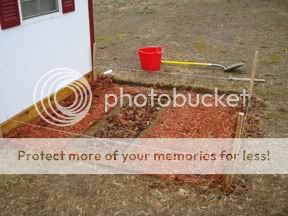
Next, I had to dig some holes. For the foundation, I decided on sonotubes filled with concrete. Underneath each sonotube is a flat rock or paver. Since I didn't want to be digging until judgement day (which is only in September for us Jews!) I decided to cut my four-foot tubes into two-foot tubes. I want to leave enough height to put rebar in with a threaded rod at the end, so that I can bolt right into the deck framing. This saves me from having to rent a hammer drill to bolt into the concrete. So here are my preliminary holes, with one sonotube sticking out, as a test:

Then, I wanted to get a sense of how much further I ought to dig each hole, so I put all the tubes in, and tested for level using a 2x4 and my four-foot level on each side, and on the diagonals. Ideally, if there is a difference, the slope should be down and away from the house. I was going for about 1/4 inch difference, if any:

Good work, kid! Very, very close. I then had to widen the holes a bit, to put the pavers in them, and tomorrow I will be putting the sonotubes back in, over the pavers, and mixing the concrete. I'm a little nervous about this part, since I've never done it before. After the concrete is set--then will be the easy part!!

Anyway, I agreed to do a screened-porch for odd neighbor Tina. It's really an addition to her playhouse, which is for her and her two sick pomeranians (don't ask!). So I decided I'd better make footings, since I'm not sure the playhouse is at all well connected to the ground, and I don't want to risk the porch blowing away. So I did the preliminary work today, and took some pictures of it, which I'm going to post and narrate, "This Old House" style. Oh, Tommy, won't you come over to my house? Anyway...
First, here is the site. It is really only about six by six feet, so it clearly can't compete with the 60,000 square foot buildings we used to do--but it's also my first 100% solo project, so I guess I'll not be too hard on me. So here's the site:

Next, I had to dig some holes. For the foundation, I decided on sonotubes filled with concrete. Underneath each sonotube is a flat rock or paver. Since I didn't want to be digging until judgement day (which is only in September for us Jews!) I decided to cut my four-foot tubes into two-foot tubes. I want to leave enough height to put rebar in with a threaded rod at the end, so that I can bolt right into the deck framing. This saves me from having to rent a hammer drill to bolt into the concrete. So here are my preliminary holes, with one sonotube sticking out, as a test:

Then, I wanted to get a sense of how much further I ought to dig each hole, so I put all the tubes in, and tested for level using a 2x4 and my four-foot level on each side, and on the diagonals. Ideally, if there is a difference, the slope should be down and away from the house. I was going for about 1/4 inch difference, if any:

Good work, kid! Very, very close. I then had to widen the holes a bit, to put the pavers in them, and tomorrow I will be putting the sonotubes back in, over the pavers, and mixing the concrete. I'm a little nervous about this part, since I've never done it before. After the concrete is set--then will be the easy part!!

Friday, March 27, 2009
Trip recap in Chinese
我去南部。
Wǒ qù nánbù.
I went south.
旅行持续了三个小时。
Lǚxíng chíxùle sāngè xiǎoshí.
The trip lasted three hours.
它是乐趣。
Tā shì lèqù.
It was fun.
Wǒ qù nánbù.
I went south.
旅行持续了三个小时。
Lǚxíng chíxùle sāngè xiǎoshí.
The trip lasted three hours.
它是乐趣。
Tā shì lèqù.
It was fun.
Thursday, March 26, 2009
At the Birches
Here I am, in Amherst, taking in the great little town here (there is a bookstore on every corner! I saw books I've never seen!). Found Hebrew and Chinese children's blocks in the toy store, and language shower curtains. And in the store next door, "barbie skulls." I bought one as a present!
Oh, and UMass. Riiight. That's why I'm here. I stopped off in Greenfield as I was driving down, and I saw the most enormous, beautiful train trestle, but I had no camera. It looked great and sad there, in the drizzle. There were also some cool storefronts in decay and a few disintegrating motel signs. And it was a good day for picture taking too, alas. Greenfield is a little depressed, but I saw some signs of life on main street there, even so--I mean it was busy, and there were some new and interesting businesses. Amherst, of course, is bustling and so is Northhampton, where Smith is I guess, which explains why--college towns. I think Northhampton is where my mom and I sang "Le Bourgeois," as we meandered down the street, but my memory could be failing too:
"Le bourgeois, all are very dumb,
the older that they get, the dumber they become!
Le bourgeois, what a bunch of pigs,
one of them is bald, and the other two wear wigs!"
(Rod McKuen's translation of Jacques Brel)
Springfield has some nice low-end houses, and also a couple of REALLY SWEET studios, if they last. It is a lot to think about. Meanwhile, I will have to try to find parking on campus tomorrow and then find History. Needless to say, it won't be the same as moving quietly through Wieboldt, through Harper, into Social Sciences, and then hovering around the second floor offices or running your hand against the paneling in 122 (?). But you can't go home again. And in any case, it would not be home any longer. It would be missing a person I love.
"I went there uncertainly, for it was foreign ground and there was a tiny, priggish, warning voice in my ear which [...] told me it was seemly to hold back. But I was in search of love in those days, and I went full of curiosity and the faint, unrecognized apprehension that here, at last, I should find that low door in the wall, which others, I knew, had found before me, which opened on an enclosed and enchanted garden, which was somewhere, not overlooked by any window, in the heart of that grey city." (EW)
Phrase of the day (and no, I'm not over it yet):
我的自行车是太复杂的。
Wǒde zìxíngchē shì tài fùzáde.
My bicycle is too complicated.
(I'm not sure if it really calls for "de" at the end, but I'll risk it.)
Oh, and UMass. Riiight. That's why I'm here. I stopped off in Greenfield as I was driving down, and I saw the most enormous, beautiful train trestle, but I had no camera. It looked great and sad there, in the drizzle. There were also some cool storefronts in decay and a few disintegrating motel signs. And it was a good day for picture taking too, alas. Greenfield is a little depressed, but I saw some signs of life on main street there, even so--I mean it was busy, and there were some new and interesting businesses. Amherst, of course, is bustling and so is Northhampton, where Smith is I guess, which explains why--college towns. I think Northhampton is where my mom and I sang "Le Bourgeois," as we meandered down the street, but my memory could be failing too:
"Le bourgeois, all are very dumb,
the older that they get, the dumber they become!
Le bourgeois, what a bunch of pigs,
one of them is bald, and the other two wear wigs!"
(Rod McKuen's translation of Jacques Brel)
Springfield has some nice low-end houses, and also a couple of REALLY SWEET studios, if they last. It is a lot to think about. Meanwhile, I will have to try to find parking on campus tomorrow and then find History. Needless to say, it won't be the same as moving quietly through Wieboldt, through Harper, into Social Sciences, and then hovering around the second floor offices or running your hand against the paneling in 122 (?). But you can't go home again. And in any case, it would not be home any longer. It would be missing a person I love.
"I went there uncertainly, for it was foreign ground and there was a tiny, priggish, warning voice in my ear which [...] told me it was seemly to hold back. But I was in search of love in those days, and I went full of curiosity and the faint, unrecognized apprehension that here, at last, I should find that low door in the wall, which others, I knew, had found before me, which opened on an enclosed and enchanted garden, which was somewhere, not overlooked by any window, in the heart of that grey city." (EW)
Phrase of the day (and no, I'm not over it yet):
我的自行车是太复杂的。
Wǒde zìxíngchē shì tài fùzáde.
My bicycle is too complicated.
(I'm not sure if it really calls for "de" at the end, but I'll risk it.)
Wednesday, March 25, 2009
Work and play
Driving down to Amherst tomorrow. Just for a quick lookaround, and maybe to schedule to sit in on a class, though I'm nervous about asking. Also to get a look at the neighborhoods. There are (weirdly) a lot of homes in the low 100s in Holyoke and Springfield, and I don't just mean the crackhouses! Though maybe they are next-door to the crackhouses, thus my exploratory mission.
I promised to build a screen-porch addition to Tina-next-door's playhouse, which is actually a doggie playhouse, which she likes to sit and have her tea in. No, not kidding! The dogs are very sickly, and she tells me they cannot touch the ground, but they now have the vet seal of approval to breathe the outdoor air I guess, so she wanted, you know, pressure treated decking, and screens, and a door, and presumably a roof to match the original playhouse, and if I want to get gingerbready with the trim, that's fine.
It actually is more work than it seems, because I have to dig holes, fill concrete sonotubes for footings, put a bolt in each, and then I can frame the actual building. And then comes the other hard part--the roofing and the screening, which I've never done. And building a door. I told them I could not dig until the ground was softer, but she cut me a check already. Yeesh! I told her to wait!
Important phrase of the day:
我的猫坐我的头。
Wǒde māo zuò wǒde tóu.
My cat sits on my head
I promised to build a screen-porch addition to Tina-next-door's playhouse, which is actually a doggie playhouse, which she likes to sit and have her tea in. No, not kidding! The dogs are very sickly, and she tells me they cannot touch the ground, but they now have the vet seal of approval to breathe the outdoor air I guess, so she wanted, you know, pressure treated decking, and screens, and a door, and presumably a roof to match the original playhouse, and if I want to get gingerbready with the trim, that's fine.
It actually is more work than it seems, because I have to dig holes, fill concrete sonotubes for footings, put a bolt in each, and then I can frame the actual building. And then comes the other hard part--the roofing and the screening, which I've never done. And building a door. I told them I could not dig until the ground was softer, but she cut me a check already. Yeesh! I told her to wait!
Important phrase of the day:
我的猫坐我的头。
Wǒde māo zuò wǒde tóu.
My cat sits on my head
Monday, March 23, 2009
I am not crazy to want a one-speed mountain bike...
...and yet, the people at Old Spokes Home looked at me like I'd got early-onset dementia. Anyway, they tell me there's nothing wrong with my blasted 21 speeds, except that I know I have some gear slippage (even in what is ostensibly first gear), which is not fun when you're trying to pedal standing up, going up a hill.
I got a temporary job with the census. Am I crazy not to apply for the historic preservation job in Alaska this summer? It's just that if I have to move to the Amherst area in August, I won't have any time left at all to enjoy my house, and given the extreme downward spiral of the world in general, perhaps this is the only and last house I will ever own before I die, so there. And all readers and/or non-readers who were invited to come visit me, well, so ends your chance. I think in my case there is a negative correlation in terms of how advanced my degree is, versus how much I get paid and how much respect I happen to receive on the job. So, as far as I can determine, when I finish my PhD, I will be living in a box by the river, "the forgotten [wo]man."
Speaking of PhDs... Finally, the U of C has posted the (long overdue) feature on Guy Alitto, the University's best professor, according to this reliable news source (me). You can read it here. But be sure to watch the video too. You get to hear Ai Kai speaking Chinese, and I especially like his colloquial use of "ai-ya," (哎呀!) in his classic Chicago Bulls story. 我惦您,尤其您的故事。 艾恺,请拜访绿色山!
I thought, yesterday, that if I had to prepare a lecture-in-a-box (you know, a 15 to 30 minute presentation for interview purposes), it might do to make it something like "Basic House Framing." I could easily discuss wall framing, layout, the difference between western and balloon frame, subfloor installation, and possibly get into roof pitches and rafter cuts. I thought this might be a good subject that most academics don't know--and then I thought, "boy, I could get myself into trouble if there's a diehard do-it-yourselfer on a faculty." I'm anticipating someone who shuns Advantech as a subfloor (although why you wouldn't be on the Advantech bandwagon I don't know), or has some alternative terminology for things (like in Florida they call a reciprocating saw (Sawzall) a "Zawsall."
I got a temporary job with the census. Am I crazy not to apply for the historic preservation job in Alaska this summer? It's just that if I have to move to the Amherst area in August, I won't have any time left at all to enjoy my house, and given the extreme downward spiral of the world in general, perhaps this is the only and last house I will ever own before I die, so there. And all readers and/or non-readers who were invited to come visit me, well, so ends your chance. I think in my case there is a negative correlation in terms of how advanced my degree is, versus how much I get paid and how much respect I happen to receive on the job. So, as far as I can determine, when I finish my PhD, I will be living in a box by the river, "the forgotten [wo]man."
Speaking of PhDs... Finally, the U of C has posted the (long overdue) feature on Guy Alitto, the University's best professor, according to this reliable news source (me). You can read it here. But be sure to watch the video too. You get to hear Ai Kai speaking Chinese, and I especially like his colloquial use of "ai-ya," (哎呀!) in his classic Chicago Bulls story. 我惦您,尤其您的故事。 艾恺,请拜访绿色山!
I thought, yesterday, that if I had to prepare a lecture-in-a-box (you know, a 15 to 30 minute presentation for interview purposes), it might do to make it something like "Basic House Framing." I could easily discuss wall framing, layout, the difference between western and balloon frame, subfloor installation, and possibly get into roof pitches and rafter cuts. I thought this might be a good subject that most academics don't know--and then I thought, "boy, I could get myself into trouble if there's a diehard do-it-yourselfer on a faculty." I'm anticipating someone who shuns Advantech as a subfloor (although why you wouldn't be on the Advantech bandwagon I don't know), or has some alternative terminology for things (like in Florida they call a reciprocating saw (Sawzall) a "Zawsall."
Wednesday, March 11, 2009
Focus group
I attended a focus group for four hours the other night; it paid $100. And I have to say, I got more out of it than just the cash. For the last few months, I've been reading articles submitted to PHN--reading them for grammatical and APA errors, mostly, but also for content. And in them, there is a lot of analysis of focus group interviews. The focus group has been used mostly for qualitative research, but also for clinical concepts and other types of papers. And I was beginning to think no one knew how to ask meaningful questions, and eke out answers that went beyond the bland or general.
And then I signed up for this focus group. Now, this was for the purposes of a courtroom case (criminal) which will be held in VT in the next year, I presume. So I won't say much about the case, but... The focus group was led by an out-of-state attorney consultant named Jim Lees, who impressed me very much. At first, second and third glance, he appears genial and disarming. Yet he is a brilliant questioner.
And I suspect that while this has something to do with his West Virginia home, I also think this is a great attribute for a trial lawyer. To be unassuming, non-committal, even friendly--until it is time for the counter-attack. He has a flair for asking incisive questions, remembering names and keeping the discussion flowing, non-stop. I can see why he does this job. Anyway, it all began with some introduction to the focus group (generally--what is a focus group, no specifics) some paperwork about our background and a confidentiality agreement (which I have no intention of breaking).
We introduced ourselves, and he asked questions of each of us, with humor, and then he asked about the local economy. He would ask specific people, remembering details about their lives from the introductions (there were 12 of us). Then, he asked us about health care. I had guessed that the case in question would be a civil case, based on some of the questions about money, compensation and frivolous lawsuits. But as we got deeper into the health care discussion, I began to see that it was no civil case.
He asked things like, "what do you expect from a doctor/practitioner?" "What could be improved upon?" "Do you (specific person) have a problem with examination by a female doctor?" and so on, and then, "what would you define as the hip?" "what would be an appropriate examination of the hip?" "how would you define consent?" "is it fair to file a complaint a day after something happens, even if you didn't speak up at the event?" and more! And we had not yet heard anything about the case, but I was beginning to get a clearer idea. He used a combination of direct questioning, (us) writing things down and then reading them, and us writing and then folding the paper and giving it to him. He made sure to get around the room, quickly and efficiently; no one was allowed to dominate discussion, and quiet people were asked specific questions.
We took a break (and I should mention that this was not taped, but there were three people taking notes in the room--all in all a very expensive focus group: 36 total participants ($3600) plus hiring the note-takers ($$) and Jim Lees' fees for the ultimate report. This creates the problem of fairness, since I'm sure a poor defendant could not have afforded this) and when we came back, the case was introduced.
We heard the details of the case--slowly (it has not been widely publicized, probably because VT is very small) because as he was talking about the case, he asked us questions about our perceptions and prior knowledge: how did we understand this specialty? Did any of the facts in the biography raise questions, and why? What did we perceive happened based on the charges, and what did we want to know?
He then played a tape (a wiretap), which was awkward to listen to, and I didn't want to meet anyone's eyes, I think, and instead--so as to focus only on the tape, and not on any reactions--I doodled on my paper, looking down. Then he asked us whether we felt the recording was damaging, and why. We talked about the tape, and the charges, and we were free to ask questions--and there were many, because there were a fair amount of details to be discussed. Lees answered them to the best of his ability, and then we had to make a judgement on the charges based on what we had heard. I have no idea what the end results were, since they were private, but I imagine they were mixed. Or so I would think--I felt like I might have been an outlier in the group, but perhaps not. Everyone, regardless of education level, took this very seriously and were earnest and thoughtful in their responses.
My guess is, though he could not say, the report was commissioned for the defense, and not for the state, though I could be wrong. I will be very interested to see how the case is resolved. At any rate, THAT is a focus group.
And then I signed up for this focus group. Now, this was for the purposes of a courtroom case (criminal) which will be held in VT in the next year, I presume. So I won't say much about the case, but... The focus group was led by an out-of-state attorney consultant named Jim Lees, who impressed me very much. At first, second and third glance, he appears genial and disarming. Yet he is a brilliant questioner.
And I suspect that while this has something to do with his West Virginia home, I also think this is a great attribute for a trial lawyer. To be unassuming, non-committal, even friendly--until it is time for the counter-attack. He has a flair for asking incisive questions, remembering names and keeping the discussion flowing, non-stop. I can see why he does this job. Anyway, it all began with some introduction to the focus group (generally--what is a focus group, no specifics) some paperwork about our background and a confidentiality agreement (which I have no intention of breaking).
We introduced ourselves, and he asked questions of each of us, with humor, and then he asked about the local economy. He would ask specific people, remembering details about their lives from the introductions (there were 12 of us). Then, he asked us about health care. I had guessed that the case in question would be a civil case, based on some of the questions about money, compensation and frivolous lawsuits. But as we got deeper into the health care discussion, I began to see that it was no civil case.
He asked things like, "what do you expect from a doctor/practitioner?" "What could be improved upon?" "Do you (specific person) have a problem with examination by a female doctor?" and so on, and then, "what would you define as the hip?" "what would be an appropriate examination of the hip?" "how would you define consent?" "is it fair to file a complaint a day after something happens, even if you didn't speak up at the event?" and more! And we had not yet heard anything about the case, but I was beginning to get a clearer idea. He used a combination of direct questioning, (us) writing things down and then reading them, and us writing and then folding the paper and giving it to him. He made sure to get around the room, quickly and efficiently; no one was allowed to dominate discussion, and quiet people were asked specific questions.
We took a break (and I should mention that this was not taped, but there were three people taking notes in the room--all in all a very expensive focus group: 36 total participants ($3600) plus hiring the note-takers ($$) and Jim Lees' fees for the ultimate report. This creates the problem of fairness, since I'm sure a poor defendant could not have afforded this) and when we came back, the case was introduced.
We heard the details of the case--slowly (it has not been widely publicized, probably because VT is very small) because as he was talking about the case, he asked us questions about our perceptions and prior knowledge: how did we understand this specialty? Did any of the facts in the biography raise questions, and why? What did we perceive happened based on the charges, and what did we want to know?
He then played a tape (a wiretap), which was awkward to listen to, and I didn't want to meet anyone's eyes, I think, and instead--so as to focus only on the tape, and not on any reactions--I doodled on my paper, looking down. Then he asked us whether we felt the recording was damaging, and why. We talked about the tape, and the charges, and we were free to ask questions--and there were many, because there were a fair amount of details to be discussed. Lees answered them to the best of his ability, and then we had to make a judgement on the charges based on what we had heard. I have no idea what the end results were, since they were private, but I imagine they were mixed. Or so I would think--I felt like I might have been an outlier in the group, but perhaps not. Everyone, regardless of education level, took this very seriously and were earnest and thoughtful in their responses.
My guess is, though he could not say, the report was commissioned for the defense, and not for the state, though I could be wrong. I will be very interested to see how the case is resolved. At any rate, THAT is a focus group.
Sunday, March 01, 2009

Subscribe to:
Posts (Atom)